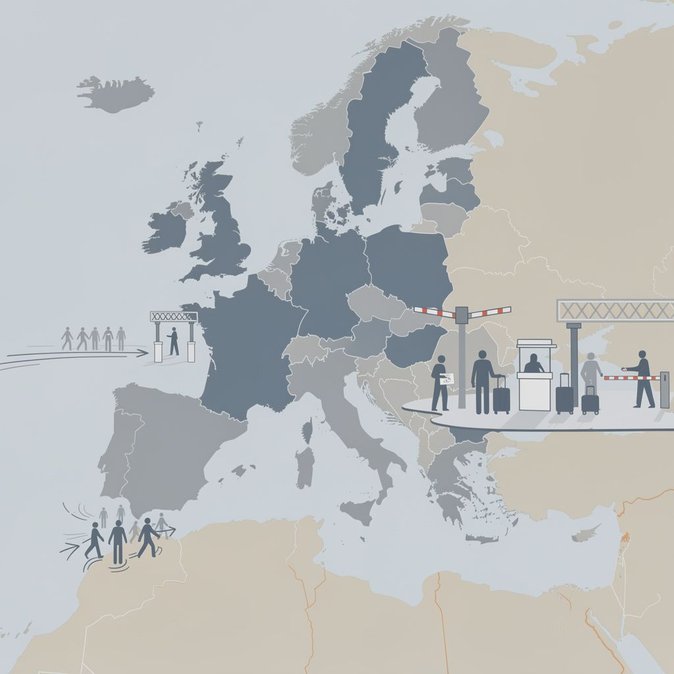
The European Union’s interior ministers will hold an unscheduled video-conference today, 4 August 2026, to discuss last week’s sudden mass crossing of an estimated 50,000 Moroccan nationals into the Spanish enclave of Ceuta. Although most of the migrants were returned within 24 hours, the incident has reignited long-simmering political tensions inside the Schengen Area and prompted calls—led in part by Berlin—for a tougher line on irregular migration. Germany’s Christian-Democrat government under Chancellor Friedrich Merz joined 21 other EU member states in a weekend letter accusing Madrid of policies that create “pull factors,” a reference to Spain’s April 2026 regularisation programme for undocumented workers already resident in the country. Berlin’s decision to sign the letter marks a sharp change from its more cautious stance at June’s European Council and reflects domestic political pressure: the governing coalition is trailing the far-right AfD in pre-election polls in Saxony, Thuringia and Brandenburg. By backing stronger controls, Merz hopes to blunt AfD criticism while demonstrating that Germany is willing to re-impose spot checks at its borders if necessary. For businesses, the Ceuta crisis may foreshadow a return to ad-hoc internal Schengen controls that bedevilled cross-border supply chains in 2023-25. Although Tuesday’s ministerial call is unlikely to produce binding measures, diplomatic sources in Brussels expect several countries—including Germany, Italy and Denmark—to signal readiness to extend or re-introduce temporary checks at land borders under Article 25 of the Schengen Borders Code. Logistics firms moving goods between Germany and Spain, as well as corporate mobility managers arranging assignee travel, should therefore prepare contingency routing options and factor in possible wait times at key crossings such as the A2 (Germany–Poland) and A3 (Germany–Austria) corridors. The crisis also heightens uncertainty around the phased launch of the EU Entry/Exit System (EES) in October 2025 and the ETIAS travel authorisation in late 2026. Some officials fear that diverging national responses to Ceuta could undermine the timetable for those digital border projects, further complicating travel-planning for visa-exempt business visitors to Germany. In the medium term, Germany’s new Skilled Immigration Act 2.0—and particularly the Chancenkarte (Opportunity Card)—relies on friction-free Schengen mobility for recruitment fairs and orientation visits. A re-fragmentation of the borderless area would increase costs for employers just as competition for talent tightens. Companies should monitor today’s EU meeting and any subsequent Bundespolizei notices, and ensure mobile workers carry proof of purpose of travel and accommodation, even for intra-Schengen journeys.
Source: Le Monde (English edition)