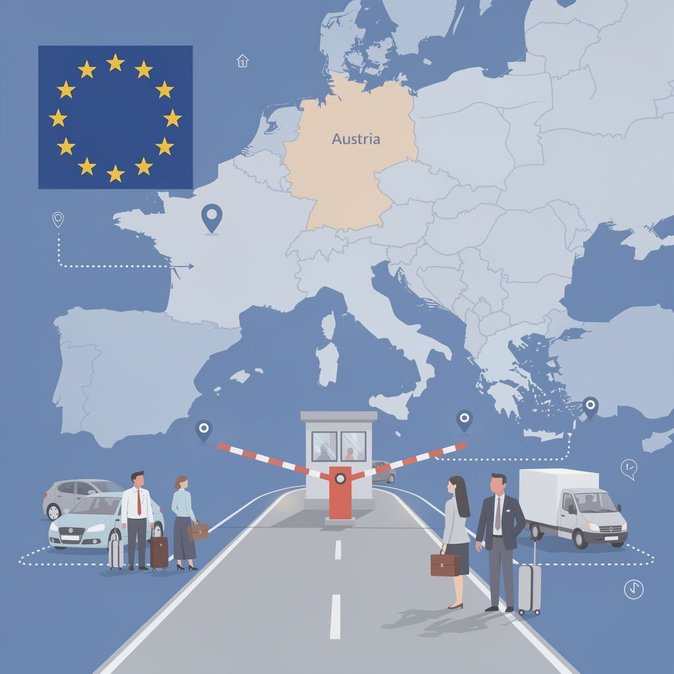
Just six months after lifting its previous round of controls, Austria has once again re-introduced passport checks on its land borders with Slovakia, Czechia, Hungary and Slovenia. The measure entered into force at 00:00 on 16 September and will run until 15 March 2027, although Vienna has left open the option of a further extension. According to the Interior Ministry, the decision was taken on the recommendation of the national security council in response to “persistently high irregular migration pressure along the Western Balkan route” and a “deteriorating international security climate” linked to Russia’s war against Ukraine and the situation in the Middle East. In practical terms, travellers should be prepared for spot checks on the main motorway, rail and secondary road crossings in Burgenland, Lower Austria, Styria and Carinthia. Freight traffic will be channelled through designated green lanes to limit delays, but logistics companies are already warning their clients to expect journey times to increase by 30–60 minutes at peak periods. Austria says the controls will be risk-based and intelligence-led, but human-rights groups point out that the country has now maintained some form of Schengen suspension for more than five consecutive years, raising questions about proportionality. For business travellers and cross-border commuters, the main headache is uncertainty. Some 35,000 Slovak residents and 14,000 Hungarians commute daily into eastern Austria; employers fear renewed queues could add unwelcome costs just as wage inflation begins to cool. The Vienna Economic Chamber is advising companies to add buffer time to supplier contracts and to encourage employees to carry residence or work-permit documentation to avoid secondary questioning. From a policy perspective, the latest Austrian move mirrors similar extensions by Germany, Denmark and Poland and underscores a wider EU debate about whether temporary Schengen derogations are becoming semi-permanent. Brussels has already issued formal opinions questioning the necessity of repeated six-month renewals, but with a new migration pact still awaiting full implementation, few expect Vienna to roll back the checks before next spring. Looking ahead, mobile workers should monitor the Interior Ministry’s website for updates and keep digital copies of travel documents on their phones. Companies running time-critical just-in-time supply chains may need to reassess routing via Croatia or northern Italy as an interim workaround.
Source: EU Today
How VisaHQ can help
VisaHQ simplifies the visa application process for individuals and businesses. Check current travel requirements, prepare the required documents and manage your application online through the VisaHQ Austria portal.More From Austria
View all
Staff shortages at Austro Control cause Friday afternoon flight delays at Vienna International Airport
Italy prolongs Schengen checks on Spain routes, creating knock-on effects for Austrian flyers