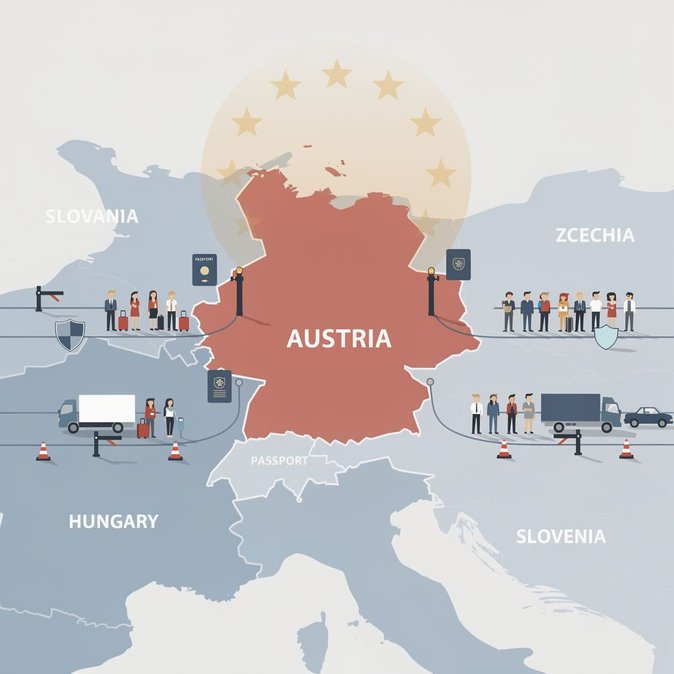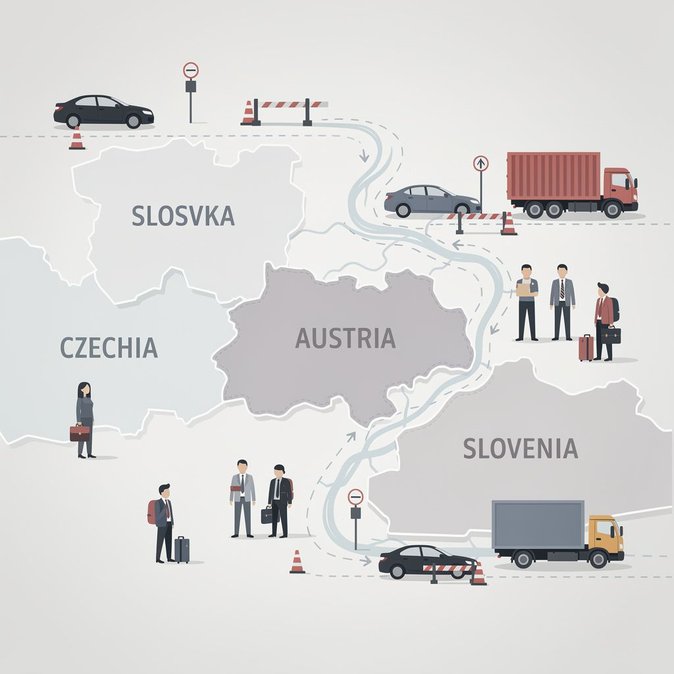
Austria has formally notified the European Commission that it is re-activating controls at all land borders with Slovakia, Czechia, Hungary and Slovenia as well as river crossings with Slovakia. The measure took effect at 00:00 on 16 September 2026 and is scheduled to remain in force until 15 March 2027. Under Article 25 of the Schengen Borders Code, member-states may temporarily restore checks at internal borders when faced with a serious threat to public order or internal security. According to the notification published by the Commission’s Directorate-General for Migration and Home Affairs, Vienna cites “continuous threats to internal security posed by irregular migration, pressure on the asylum-reception system, Russia’s ongoing war of aggression against Ukraine, the security situation in the Middle East, and recent incidents in Ceuta” as the main drivers. The Interior Ministry says the return to a “broad, flexible control belt” will allow police to target people-smuggling networks while minimising disruption for bona-fide commuters and freight traffic. For global mobility managers the decision has immediate operational implications. Staff who regularly cross the eastern borders—including thousands of Hungarian and Slovak cross-border commuters working in Austria’s manufacturing and logistics hubs—should carry passports or national ID cards and build extra time into their journeys. Companies that rely on just-in-time deliveries from suppliers in neighbouring countries are being advised to review contingency stocks and make use of Austria’s AEO fast-track customs lanes where available. The prolonged controls also interact with the new Entry/Exit System (EES) that went live earlier this year. Third-country travellers whose biometric data has to be captured could face duplicate checks if capacity at smaller crossing points is limited. Austrian authorities have promised additional mobile enrolment units and say they will prioritise business travellers holding Schengen multi-entry visas or residence permits. While border checks are permissible for up to six months, Austria has already used the maximum two-year period allowed under the Schengen rules several times since 2015. Brussels is therefore likely to scrutinise the proportionality of the latest extension closely. Nevertheless, most analysts expect the controls to remain until at least the end of the current winter timetable, given parallel measures in Germany, Poland and Italy.