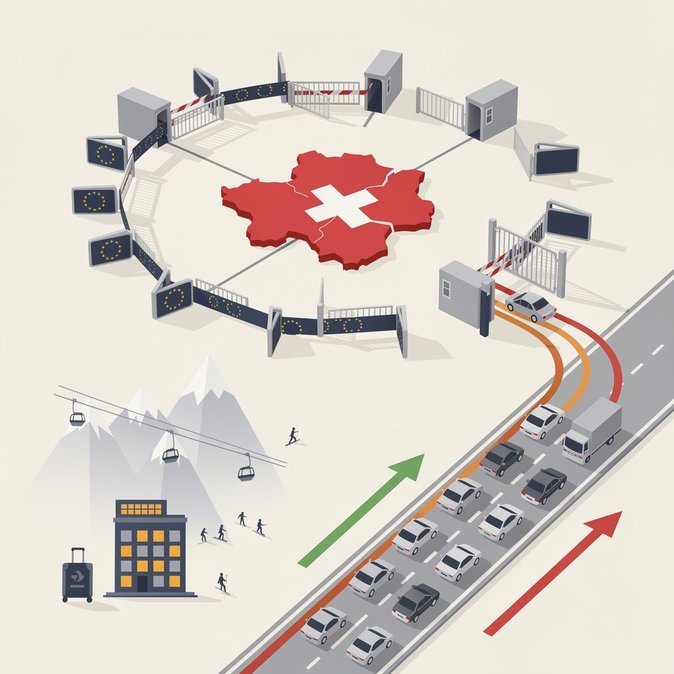
A federal report published on 18 September 2026 quantifies for the first time the macro-economic value of Switzerland’s membership in the Schengen and Dublin accords. According to the study, commissioned by parliament amid rising eurosceptic pressure, gross domestic product would be up to 3.9 % lower in 2035 if the country withdrew—equivalent to CHF 1,300 less per resident every year. The analysis breaks down the projected losses: labour-intensive sectors such as healthcare and hospitality would struggle to replace the 345,000 daily cross-border commuters who currently reach Swiss workplaces unhindered; traffic delays at re-instated checkpoints could cost firms between CHF 1.08 billion and CHF 2.27 billion annually. Tourism would forfeit as much as CHF 810 million in visitor spending because travellers would need a standalone Swiss visa instead of the widely accepted Schengen permit. Security repercussions feature prominently. Without real-time access to shared police, customs and intelligence databases, authorities fear that threats ranging from people-smuggling to cyber-crime could be detected too late. Asylum procedures would lengthen because Switzerland could no longer transfer applicants to the first Dublin state they entered, adding up to CHF 824 million in extra costs for cantonal welfare budgets. The timing is strategic: the report accompanies the Federal Council’s rejection of the “Border-Protection Initiative”, giving lawmakers and voters concrete figures ahead of a likely referendum campaign. Business associations, including economiesuisse and HotellerieSuisse, immediately seized on the findings to warn that ending Schengen would dent Switzerland’s attractiveness for multinational headquarters and international events. While eurosceptic groups dismissed the study as “alarmist”, centrist parties argue that the numbers underscore how deeply integrated Swiss mobility has become with the European single market. The debate now shifts to parliament, where any decision to quit Schengen would require majority backing in both chambers and a nationwide vote.
Source: SWI swissinfo.ch