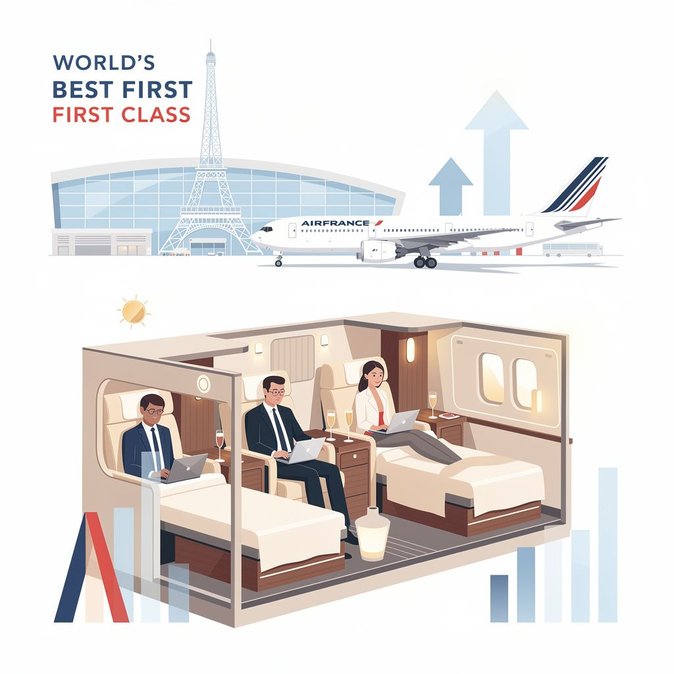
At London’s Skytrax World Airline Awards on 18 September 2026, Air France walked away with the coveted title of ‘World’s Best First Class’, alongside gongs for best First-Class lounge and catering. The recognition comes as the carrier finishes retrofitting its flagship Boeing 777-300ER fleet with La Première suites—featuring floor-to-ceiling privacy doors, a full-length bed and Michelin-level dining. For France’s global-mobility ecosystem the win is more than a branding coup. Paris-Charles-de-Gaulle serves as continental Europe’s second-largest long-haul hub, handling a high share of premium traffic generated by multinationals headquartered in the capital and by tech clusters in Île-de-France and Lyon. Enhanced cabin products strengthen France’s competitiveness against Middle-Eastern and Asian hubs courting the same executive travellers. Corporate-travel managers note that La Première’s 4-seat configuration limits availability but offers unrivalled privacy for C-suite flyers who need to work inflight under strict confidentiality rules. The product can also mitigate duty-of-care risks on ultra-long sectors to Santiago or Johannesburg by providing fully flat beds and inflight connectivity suitable for tele-consultations with medical staff. From a policy perspective, the award dovetails with France’s push to attract foreign investment: Business France’s “Choose France” roadshows frequently highlight the flag-carrier’s premium network as a soft-power asset. While sustainability activists criticise first-class emissions, Air France counters by pointing to its contrail-mitigation research and fleet modernisation. Travel buyers should expect upward pressure on negotiated premium fares, especially on routes where La Première replaces older business-class seats. Companies may need to revisit travel-policy thresholds to balance employee well-being, confidentiality needs and carbon budgets.