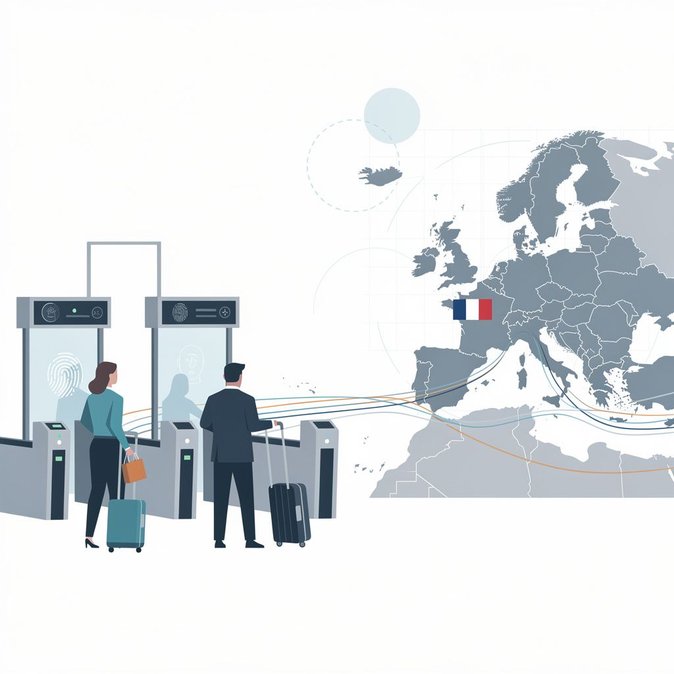
The European Commission is quietly allowing France and eight other Schengen members to apply the new Entry/Exit System (EES) with a degree of flexibility beyond the 6 September deadline that officially ended the transition period. EES, live since 10 April 2026, records fingerprints and facial images for almost every non-EU short-stay visitor, including British nationals. Paris had warned Brussels that imposing the full biometric workflow in one go risked gridlock at Channel ports, Paris-CDG and major rail terminals where French officers perform ‘juxtaposed’ exit checks for UK-bound travellers. Logistics UK has modelled that each additional 90-minute delay on the Dover–Calais corridor could cost British supply chains £400 million per year. By tacitly accepting a phased approach—where officers can skip fingerprints at peak times—Brussels hopes to avoid that scenario. Crucially, the Commission has issued no new legal act; member states remain bound to reach full compliance. In practice, however, French border police may keep using the “exceptional crowd-management switch-off” envisaged in Regulation (EU) 2025/1534 until new fingerprint kiosks and e-gates are installed later this winter. This mirrors the 2017 roll-out of Smart Borders, when several airports were allowed to run manual fallback lanes months after the official start date. For corporate mobility managers the message is mixed. Travellers will benefit from shorter queues in the short term, but they must still plan for sporadic biometric registration that can add 30 minutes to departure or arrival. Hauliers crossing at the Eurotunnel and the ferry ports should continue to schedule generous buffers—especially on Friday evenings and Monday mornings when leisure traffic peaks. Global mobility teams should also update employee travel briefs to reflect the possibility that the same traveller may be finger-printed on one trip and waved through on the next, depending on traffic density. France’s Transport Ministry reiterated that the country “remains fully committed to the EES timetable” and that the present tolerance “must not be confused with an extension of the derogation.” Companies should therefore expect a progressive tightening of controls as infrastructure catches up, likely before the Christmas travel rush.
Source: Trans.info