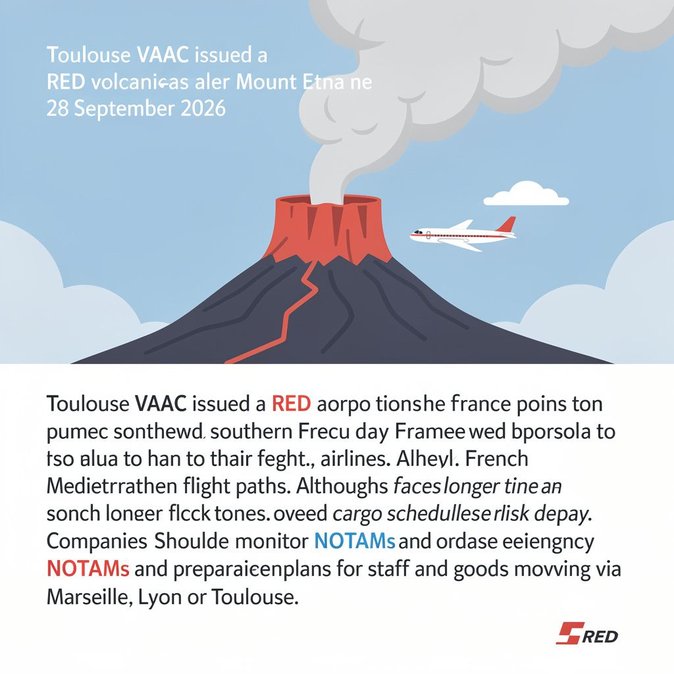
The Toulouse Volcanic Ash Advisory Centre (VAAC), one of nine global aviation-ash monitoring hubs, elevated its alert level for Mount Etna to RED at 10:00 UTC on 28 September 2026, forecasting ash up to flight level 140 and projecting the plume’s 18-hour trajectory across parts of the western Mediterranean. While Sicily’s Catania Airport suspended operations, French carriers Air France and Transavia pre-emptively re-routed southbound corridors linking Marseille FIR to North Africa to avoid ash contamination. According to the VAAC bulletin, fine particles could enter French airspace over Corsica and the Gulf of Lion under prevailing mistral winds. The French civil-aviation authority (DGAC) has not closed airspace but issued NOTAMs instructing crews to carry an additional 600 kg of contingency fuel to accommodate diversions. Aircraft already airborne from Paris to North-African destinations reported vectoring around restricted sectors, adding up to 25 minutes to block times. Logistics providers warn that nocturnal cargo flights from Lyon and Toulouse to Tunis and Algiers may be delayed, potentially disrupting just-in-time automotive supply chains that rely on belly-hold capacity. Businesses should monitor shipment tracking and consider switching urgent consignments to overland routes via Spain if ash forecasts worsen. Travel-risk consultants advise companies with employees transiting through southern French airports to stay alert for sudden schedule changes. Historical data show Etna eruptions can produce intermittent ash for several days; if accumulation on French runways exceeds safety thresholds, authorities can order rapid closures, as occurred in February 2025. Employers should disseminate contingency instructions for travellers holding short-stay Schengen visas nearing expiry; unexpected layovers in France could trigger over-stay risks once the EES system logs exit times. Carriers must accommodate stranded passengers, but visa validity remains the traveller’s responsibility.