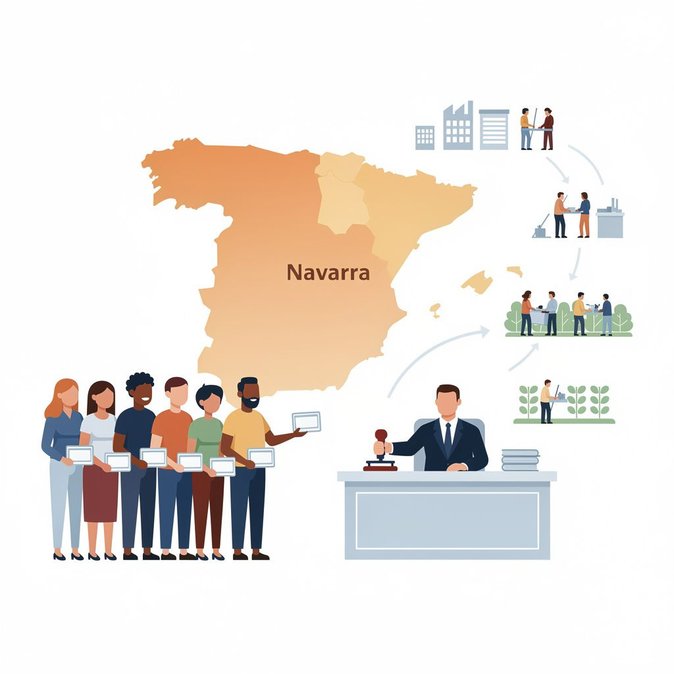
Speaking before the regional parliament on 29 September, Begoña Alfaro—Navarra’s Vice-President for Housing, Youth and Migration—gave a ‘positive but qualified’ assessment of Spain’s extraordinary regularisation drive for undocumented migrants. Navarra logged 14,886 of the 1.17 million applications filed nationwide before the 30 June cut-off, with Colombians (26.6 %), Moroccans (19.8 %) and Peruvians (11 %) topping the list. Roughly 4,465 beneficiaries were already registered with Social Security by 31 August, suggesting many had informal employment prior to obtaining papers. Another 2,007 have since enrolled with the regional employment office, mainly in cleaning, manufacturing and construction. However, Alfaro warned that gaps in consular documentation—particularly for Algerian applicants—mean a share of petitions will be refused, and that irregular inflows are likely to resume. The vice-president credited Navarra’s decision to subsidise NGOs and unions that acted as certified mediators, contrasting it with what she called the “obstructionist stance” of conservative-led regions. Opposition lawmakers acknowledged the humanitarian benefits but pressed for stronger integration pathways to avoid creating a ‘second shadow economy.’ For employers, the update offers an early snapshot of how the national regularisation is feeding skilled and semi-skilled labour markets. HR teams should prepare for tighter enforcement of payroll compliance as newly documented workers shift from cash-in-hand arrangements to formal contracts. Companies that relied on subcontractors should audit supply chains to ensure social-security registration is up to date. At national level, the Ministry of Inclusion is expected to release preliminary acceptance and rejection rates next month, a data point mobility specialists will watch closely to gauge the scheme’s effectiveness and potential need for follow-up reforms.
Source: Cadena SER – Radio Pamplona