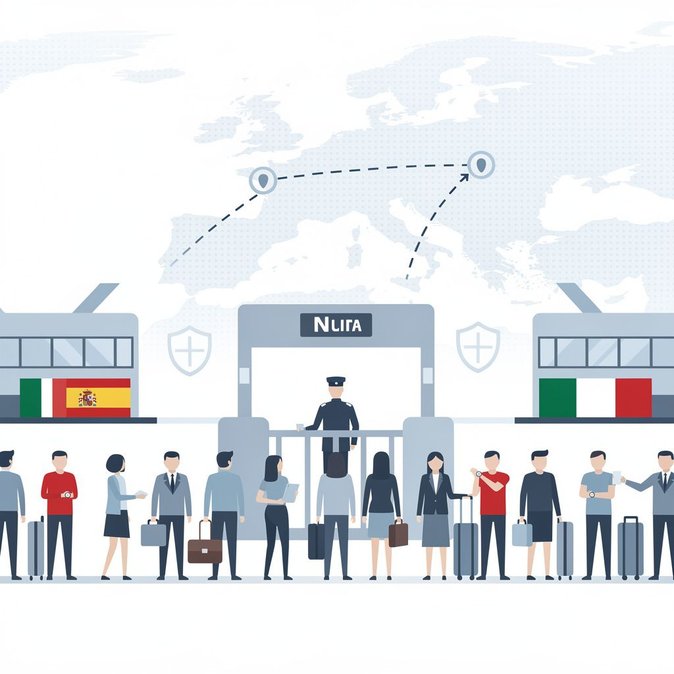
Spain has formally notified the European Commission that it will maintain temporary controls at its internal air- and seaports with Italy through 7 October 2026. The measure, first activated on 23 September after a sudden spike in secondary movements linked to the Ceuta migration crisis, invokes Articles 25 and 26 of the Schengen Borders Code, which allow member states to restore border checks when public order or internal security are under serious threat. According to the Commission’s public register of notifications, Madrid says the decision is a ‘last-resort’ response to “large-scale movements of third-country nationals within the Schengen area, including the risk of secondary movements.” Italian authorities introduced mirror checks on 16 September, creating the first bilateral air-and-sea frontier inside Schengen since the pandemic. Although travellers can still move freely, they must now show a passport or national ID and should expect spot checks, longer queues and possible schedule adjustments as airlines and ferry operators adapt. For business travellers and mobility managers the extension means at least another week of potential disruption on one of Spain’s busiest intra-EU corridors. Barajas-Fiumicino alone handles around 60 weekly frequencies, while Barcelona, Valencia and Palma have heavy short-haul traffic to Milan, Rome and Venice. HR teams with frequent flyers between the two countries are advised to carry hard copies of residence permits and assignment letters, build extra time into itineraries and monitor carrier briefing notes for check-in cut-off changes. Legal experts note that Spain remains within the six-month ceiling for foreseeable-event controls, but warn that an additional renewal would require a detailed risk assessment. “If the Ceuta situation is not stabilised soon, we could see controls rolled over into the Christmas peak,” says immigration lawyer Marta Ruiz. EU Home Affairs officials have so far accepted the proportionality of the measure but stress that Schengen safeguards “must remain exceptional and temporary.” A formal Commission opinion is expected later this week. In the meantime, companies running rotational assignments between Spain and Italy should review duty-of-care protocols, remind staff that electronic national IDs are valid at the temporary checkpoints, and consider alternative routings via France or Portugal if time-critical connections are at stake.
Source: European Commission – DG Home