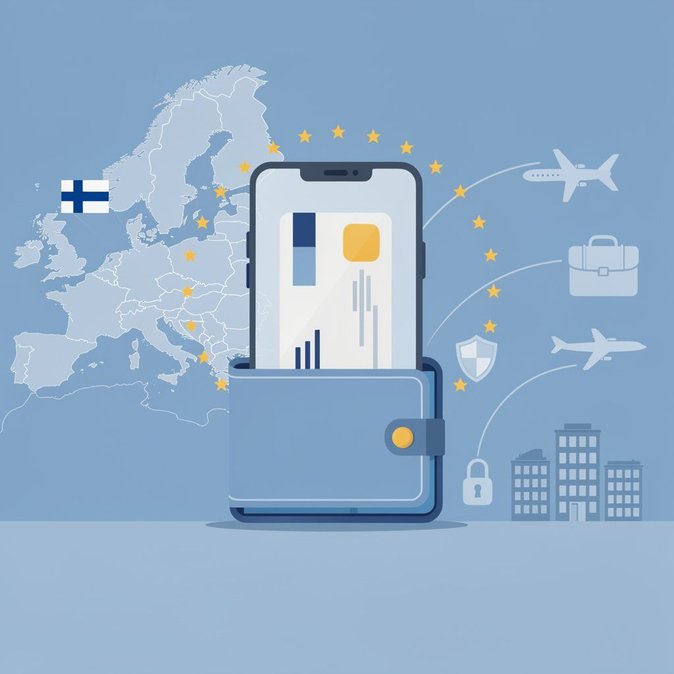
Finland took a decisive step toward the EU-wide adoption of the European Digital Identity (EUDI) Wallet on 1 October 2026, when legislation granting the government supervisory powers over wallet providers officially entered into force. Under the new act, the Digital and Population Data Services Agency (DVV) will issue and manage the state-backed wallet, while the Finnish Transport and Communications Agency (Traficom) will maintain a register of approved private-sector wallet providers and monitor their compliance. The law makes Finland one of the first EU member states to have a complete oversight architecture in place for the EUDI Wallet, which all member states must offer by 1 January 2027 under the revised eIDAS 2.0 Regulation. Users with a valid Finnish passport or national ID card will be able to download a digital credential into the wallet, allowing them to prove their identity online or at border crossings with a single tap. The system is designed to give citizens granular control over what personal data they share while meeting the high Level of Assurance requirements set by the EU. From a global-mobility perspective, the wallet promises to streamline travel across the Schengen Area by replacing physical documents with cryptographically secure digital equivalents that can be verified even when a traveler is offline. For employers and relocation managers, the move should reduce onboarding friction by enabling instant, cross-border identity checks and the automated filling of immigration forms that rely on biometric or personal-data validation. Finland’s early implementation also signals opportunities for Finnish technology vendors, as private providers that meet the technical and security requirements may apply to issue their own wallets or value-added credentials (for example, digital residence permits or professional licenses). Multinational companies operating in Finland should therefore begin integrating wallet-based verification into their HR and travel-management systems to stay ahead of the 2027 deadline. The Ministry of Finance has said pilot use cases will begin in 2026, giving businesses a short window to test integrations before mass roll-out.
Source: Biometric Update