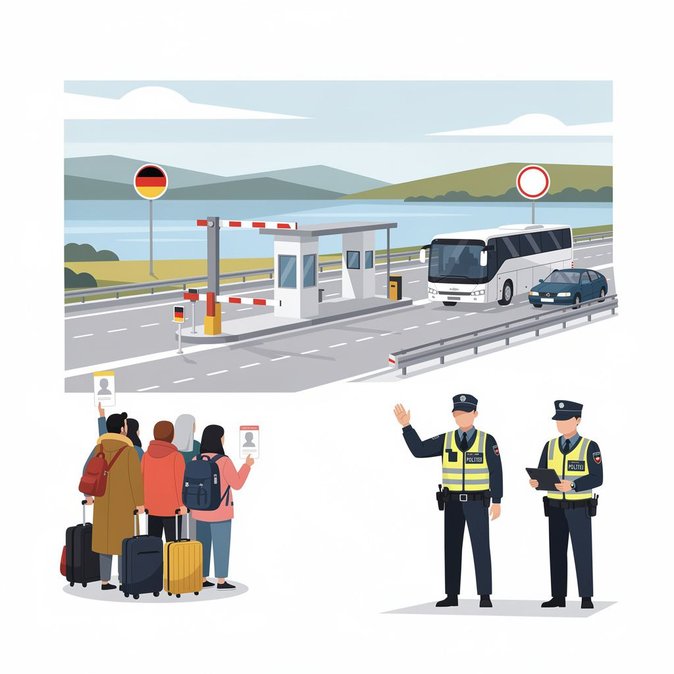
German Federal Police based in Kempten reported on 8 October that they had intercepted eleven third-country nationals attempting to enter Bavaria by road and rail at the Hörbranz–Lindau section of the German-Austrian frontier. During two spot checks on international long-distance buses travelling the Milan–Białystok and Rome–Frankfurt corridors, officers discovered travellers from Afghanistan, Sri Lanka, Kosovo and Iraq who lacked valid Schengen documents. In the highest-profile case, a five-member Afghan family carrying only national passports and a forged ID card was denied entry after paying a €900 security deposit and was returned to Austria the same day. Other detections included a Sri Lankan national whose Romanian residence permit had been cancelled in April, three Kosovars with expired Italian or German permits, and an Iraqi man with Italian refugee papers who intended to settle permanently in Germany. A Kyrgyz driver with an invalid Italian residence card and an Iranian rail passenger were also refused entry and sent back across the border. The incident highlights the continuing secondary-migration pressure along the Western Balkan and Alpine routes despite extended internal Schengen controls. Austria has prolonged its own land-border checks with Slovakia, Czechia, Hungary and Slovenia until at least March 2027, while Germany re-introduced controls on 16 September citing similar concerns. The Hörbranz crossing on the A96 motorway is a key choke point for coach traffic between northern Italy, Austria and southern Germany. For corporate mobility teams the case underscores the importance of checking that assignees and business travellers carry residence permits whose validity has not lapsed in another member state—an increasingly common compliance pitfall given differing national renewal cycles. Employers should also remind staff that overstaying or travelling on cancelled permits can trigger SIS alerts that bar re-entry and complicate future visa applications. From a policy standpoint, the episode will feed into German-Austrian discussions on joint police patrols and the EU’s forthcoming Schengen Borders Code reform, which aims to balance free movement with security imperatives. Logistics operators running employee shuttles or crew rotations across the border should anticipate ad-hoc delays and factor buffer time into schedules over the autumn peak.
Source: VOL.AT