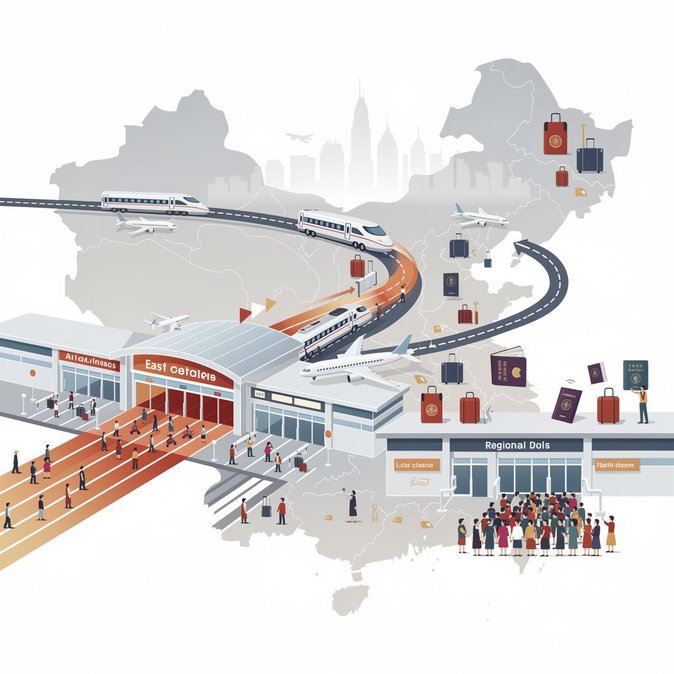
Official statistics released on 10 October paint the clearest picture yet of China’s National-Day travel rush. Over the eight-day Golden-Week holiday, 1.546 billion people crossed China’s borders, averaging 220.9 million movements a day and peaking at 239.7 million on 4 October, according to the National Immigration Administration. Domestic mobility was equally robust: the Ministry of Transport reported 2.142 billion intra-country trips across rail, road, air and waterways. Rail set a single-day record by moving 25.2 million passengers, while regional airports such as Chengdu Tianfu and Haikou Meilan posted double-digit growth in tourist arrivals. Immigration officials attribute the smoother flow to predictive analytics and an early-warning system that pushed real-time crowd alerts to social-media channels and navigation apps. Border garrisons deployed extra officers and opened pop-up self-service kiosks at peak hours, reducing average clearance time to 12 minutes even at the busiest checkpoints. For employers the numbers point to a fully-normalized travel environment: sales teams can now schedule post-holiday field visits without fear of sudden capacity caps or testing mandates. However, the surge also reveals latent bottlenecks. Airports in second-tier cities reported jet-bridge shortages, and several land crossings hit temporary vehicle backlogs, suggesting that infrastructure upgrades will be needed before the 2027 Asian Games. Mobility managers should expect higher airfares and tighter hotel inventory around China’s next major holidays (New Year’s and Spring Festival) and may need to budget for premium cabin bookings to secure space.