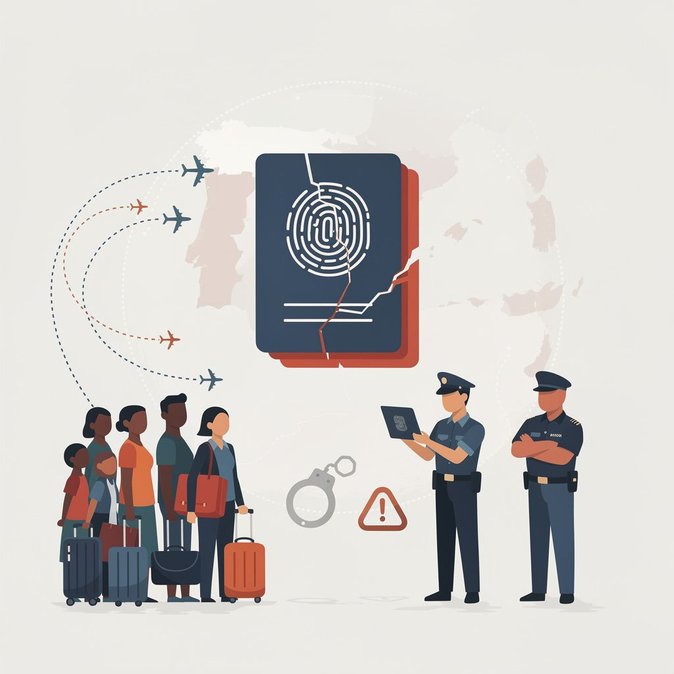
Spain’s National Police have broken up a sophisticated people-smuggling network based in Sabadell (Barcelona) that specialised in moving Dominican nationals into the European Union with falsified Colombian passports. The investigation began in November 2025 when officers detected a pattern of travellers from the Dominican Republic arriving at Madrid-Barajas with Colombian documents that did not match biometric records. After almost a year of surveillance, raids carried out on 14 October 2026 led to the arrest of eight Spaniards and Dominicans and the seizure of a cache of blank passports, counterfeit visa stickers, printers and €72,000 in cash. Police say the ring exploited the visa-exemption enjoyed by Colombian citizens to move clients through Bogotá, Lima and São Paulo before connecting them to Europe, where handlers in Catalonia provided shelter and onward travel. Migrants paid between €8,000 and €12,000 per person, a price that included false documents, routing, coaching on border interviews and – in some cases – forged Italian residence cards to smooth Schengen travel once inside Spain. The dismantling of the cell comes as Spain faces renewed scrutiny from Brussels over secondary movements stemming from the July Ceuta crisis. It also exposes the growing role of Latin American organised crime groups in supplying Europe’s labour-short hospitality and care sectors with irregular workers. Investigators believe the network smuggled at least 320 people in the past 18 months – enough to trigger money-laundering red-flags at Spanish banks used to funnel payments via remittance services. For employers, the case is a reminder that hiring undocumented staff carries fines of up to €10,000 per worker under Spain’s Immigration Act. Global mobility managers should review document-verification protocols, especially when onboarding Latin American hires whose biometric data may not yet be enrolled in Spain’s foreign-resident register (NIE). Companies running shared-service centres in Catalonia were advised by the regional police liaison unit on Wednesday to audit subcontractors supplying cleaning and catering staff. Looking ahead, the Interior Ministry hinted that it will ask EU-LISA to prioritise the Dominican Republic in the next biometric-data-sharing upgrade to the Entry/Exit System (EES) before it goes fully live in April 2027 – a move that would make it far harder to recycle genuine passports with substituted photos.
Source: Ministerio del Interior (Spain)