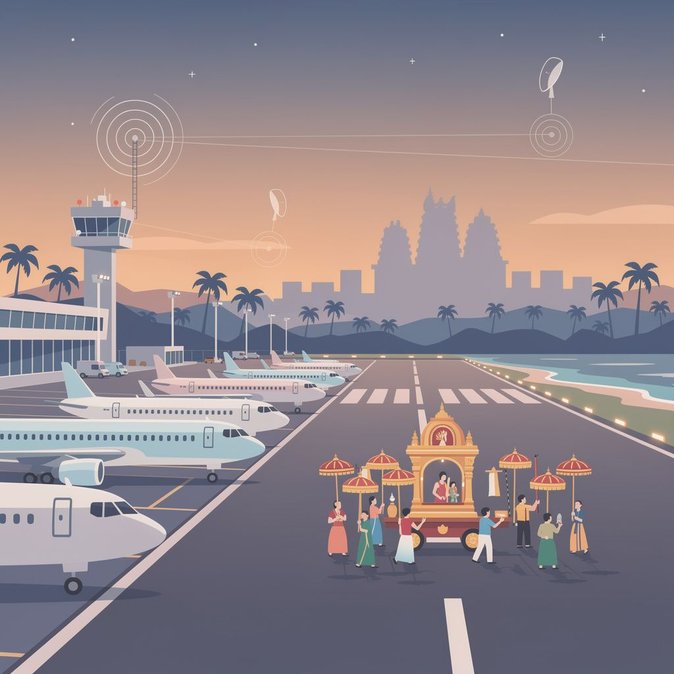
Air operations at Thiruvananthapuram International Airport (TRV) were suspended from 16:00 to 21:00 IST on 20 October 2026 to allow the centuries-old ‘Alpasi Arattu’ procession of the Sree Padmanabhaswamy Temple to cross the active runway. The ritual, led by the erstwhile Travancore royal family, physically exits the temple complex, traverses airport land and proceeds to the Shanghumugham beach for a ceremonial dip before returning via the same path. Thiruvananthapuram International Airport Ltd (TIAL) worked with airlines to reschedule 67 movements: 32 departures and 35 arrivals. Long-haul services to Dubai, Singapore and Kuala Lumpur were retimed outside the closure window, while four domestic IndiGo rotations were cancelled outright. The airport operator advised passengers to confirm revised timings and reported that normal operations resumed at 21:03 without backlog. For corporates, the disruption highlights the idiosyncratic local factors that can upend travel even in non-metro markets. Kerala’s IT and life-sciences clusters rely on TRV for investor visits and expatriate churning; programme managers should therefore note the bi-annual Arattu dates (the spring ‘Painkuni’ and autumn ‘Alpasi’ festivals) when drafting travel policies. Travel insurers classify the closure as a ‘known event’, so new policies issued after 18 October will typically exclude related losses. On the upside, TIAL completed its first live test of a newly installed Airport Collaborative Decision-Making (A-CDM) module, sharing dynamic slot updates with airlines and the Airports Authority of India’s flow-management portal. Industry observers say the experience could serve as a template for managing predictable cultural-event closures at other Indian airports such as Bhubaneswar (Rath Yatra chariot pulling) and Jaipur (Ganesh idol immersion).
Source: The Print (PTI feed)