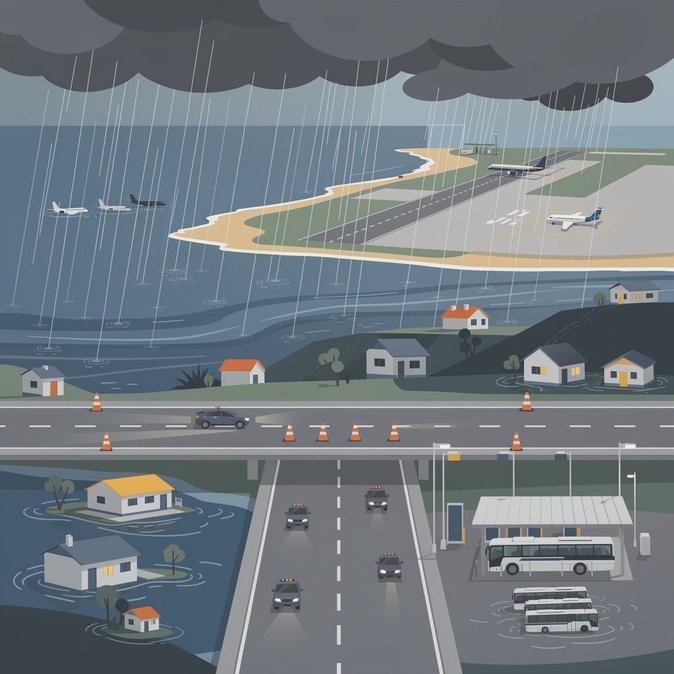
Brazil’s National Institute of Meteorology (INMET) issued a ‘Perigo’ (danger-level) heavy-rain alert overnight for the Sul Baiano zone of Bahia, valid from 09:15 to 23:59 on 11 November 2026. The bulletin forecasts precipitation of up to 60 mm per hour or 100 mm in a single day, with explicit warnings of flash flooding, river overflow and landslides on saturated slopes. While weather alerts are common during Brazil’s spring rainy season, the ‘Perigo’ classification is INMET’s second-highest tier and triggers automatic contingency measures by state civil-defence authorities. The highway police (PRF) have already imposed speed restrictions on stretches of the BR-101 and BR-415 corridors, while inter-municipal bus company Águia Branca cancelled 14 departures from Itabuna and Ilhéus citing impassable road segments. Salvador’s Deputado Luís Eduardo Magalhães Airport is operating, but ground handlers warn of possible diversions if runway visibility drops below 800 metres. For corporate mobility managers, the immediate concern is duty-of-care: assignees housed in coastal municipalities such as Ilhéus, Itacaré and Porto Seguro should be advised to avoid low-lying neighbourhoods near river mouths and to monitor local civil-defence SMS alerts. Companies with site visits to cocoa-belt facilities may need to postpone travel, as secondary roads are prone to wash-outs and landslips. Experience from previous Sul Baiano events suggests that infrastructure recovery can take several days. During the December 2021 floods, for example, more than 20 bridges were destroyed and thousands of travellers were stranded. Organisations should therefore refresh their business-continuity protocols: validate staff locations, ensure emergency contact lists are current, and verify that accommodation bookings include flexible re-accommodation clauses. Travellers holding Brazilian domestic tickets can usually rebook without fees when an INMET “Perigo” bulletin is in force, but must contact airlines before scheduled departure. Although the warning is presently confined to Bahia, meteorologists note that the same moisture plume could shift south-east towards Espírito Santo within 24 hours. Mobility teams with rotational workers moving along the coast should keep contingency transport options—such as flying São Paulo-Vitória instead of using the coastal highway—on standby until the system weakens.