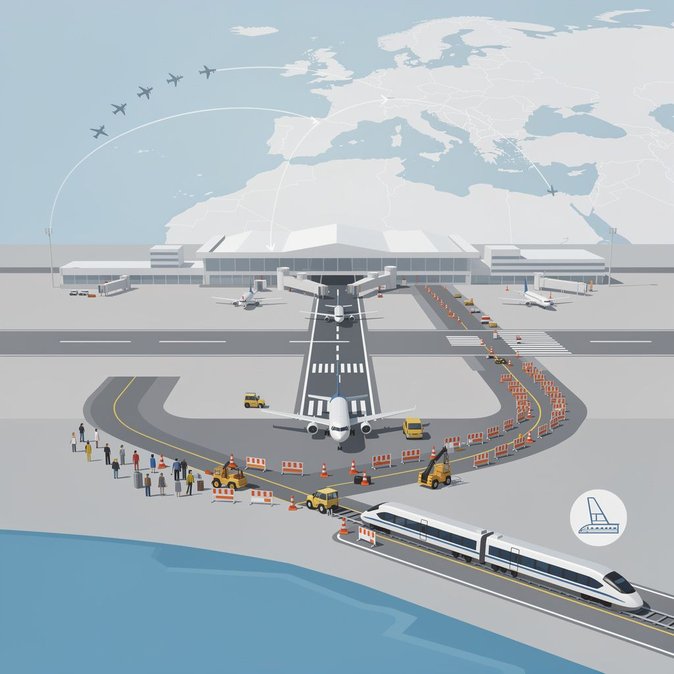
Barcelona’s main international gateway, Josep Tarradellas Barcelona-El Prat Airport (BCN), entered the most disruptive phase of an €3.1 million runway-improvement project at 06:00 on Monday, 16 November 2026. For eleven consecutive days—until 26 November—the airport will work with only the coastal runway 06R/24L, while the transverse 02/20 runway is closed to install a rapid-exit taxiway and the parallel 06L/24R is reserved for contingency. Airport operator Aena has withdrawn 1,441 take-off and landing slots, about 15 % of total capacity, after consultations with airlines. The curtailment is already visible on departure boards: peak-morning departures have been spaced at six-minute intervals instead of the usual four, and carriers report extended ground times to keep aircraft sequencing stable. Vueling, BCN’s largest customer, says it has consolidated some off-peak flights by up-gauging aircraft but expects to operate 93 % of its schedule. Long-haul carriers such as LATAM and Qatar Airways have preserved their slots by retiming inbound flights into the late evening wave. Business-travel managers are advising travellers to build in at least two extra hours at both ends of their itineraries. In the short haul, the rail alternative to Madrid (2h 45 m AVE) and Valencia (3h 15 m Euromed) is absorbing spill-over demand, while meetings planners are shifting intra-company events to hybrid formats. Freight forwarders warn that belly-hold capacity for just-in-time e-commerce could tighten during the Black Friday period, forcing some shippers to route via Madrid-Barajas or Zaragoza cargo hubs. The works are part of a wider plan to raise BCN’s hourly movements from 78 to 90 without extending the footprint of the airport—a politically sensitive compromise after the 2024 cancellation of the parallel-runway expansion. According to Aena’s timeline, normal three-runway operations will resume on 27 November, and the rapid-exit taxiway will become fully operational by mid-December. Until then, travellers should expect ongoing schedule adjustments and potential knock-on delays in the wider European network as winter fog reduces runway throughput even further.
Source: La Vanguardia / Pixidia