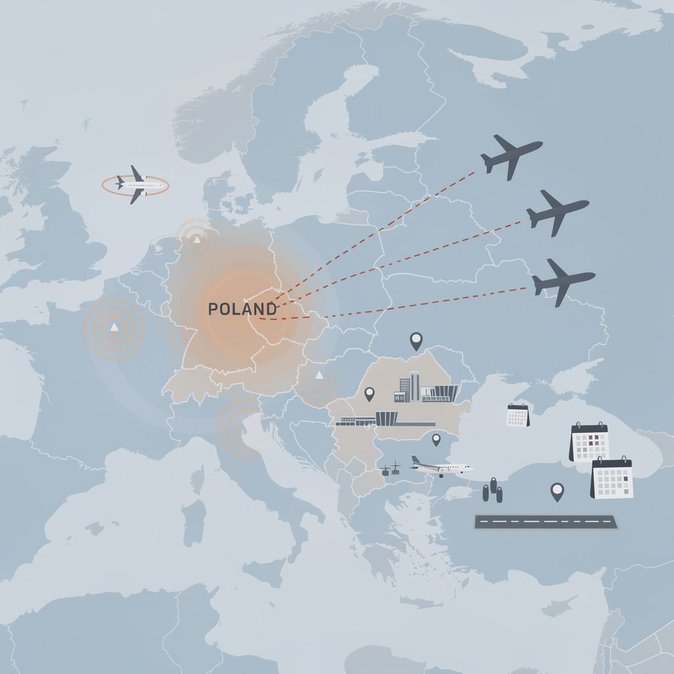
Poland woke up on 20 November 2026 to the news that two Russian Kh-101 cruise missiles and what Polish military experts believe was a jet-powered reconnaissance drone had crossed Ukraine’s frontier and fallen on Polish territory. One missile came down near Nowa Dęba, Podkarpackie province, while the second fell roughly 30 km from the Ukrainian border outside the village of Chmielek in Lubelskie. No casualties were reported, but the debris spread across farmland situated under key civilian flight corridors linking Warsaw Chopin Airport with south-eastern Europe. Prime Minister Donald Tusk called the incident “a deliberate provocation designed to test NATO’s resolve,” adding that fragments landed during a period of heightened allied manoeuvres in the region. Within 30 minutes of the strikes, the Polish Air Navigation Services Agency (PANSA) issued a NOTAM instructing civilian aircraft to avoid airspace below 8,000 m within a 40-km radius of the impact sites; LOT Polish Airlines and Ryanair immediately rerouted morning rotations from Rzeszów and Lublin to Kraków and Katowice. Rail operator PKP Intercity suspended services on the broad-gauge line to Hrubieszów pending explosive-ordnance sweeps of the track bed. The Ministry of the Interior raised the national ALFA-CRP alert level, meaning additional border-passport checks were implemented at road crossings with Ukraine and Belarus. Business travellers heading to the Lublin and Rzeszów special economic zones were advised to carry passports rather than ID cards and to allow an extra hour for inspection. Logistics firms moving automotive components from Slovakia through Poland to German plants reported delays of up to four hours on the A4 motorway because of military convoys repositioning air-defence batteries. Although Poland has maintained a 30-km restricted flight zone along its eastern flank since early 2025, Friday’s events are the first time since the 2023 Przewodów tragedy that missile debris has landed inside the country. NATO’s Allied Air Command confirmed that Spanish Eurofighters on Baltic Air Policing duty were scrambled but arrived after the objects had already struck the ground. The alliance reiterated that Article 5 consultations would be initiated only if evidence shows intentional targeting of Polish territory. In practical terms, travellers should expect rolling air-space restrictions, flight diversions around Rzeszów-Jasionka Airport—the logistics hub for humanitarian corridors into Ukraine—and sporadic passport checks at internal Schengen borders for at least several days. For global-mobility managers, the key takeaway is to monitor real-time NOTAMs and to brief assignees in eastern Poland on shelter-in-place procedures. Companies with staff transiting between Kraków and Kyiv via Rzeszów should build additional layover time into itineraries and keep employees registered on the Polish Government’s RCB Alert SMS system, which pushes geolocated security warnings in both Polish and English.
Source: Associated Press