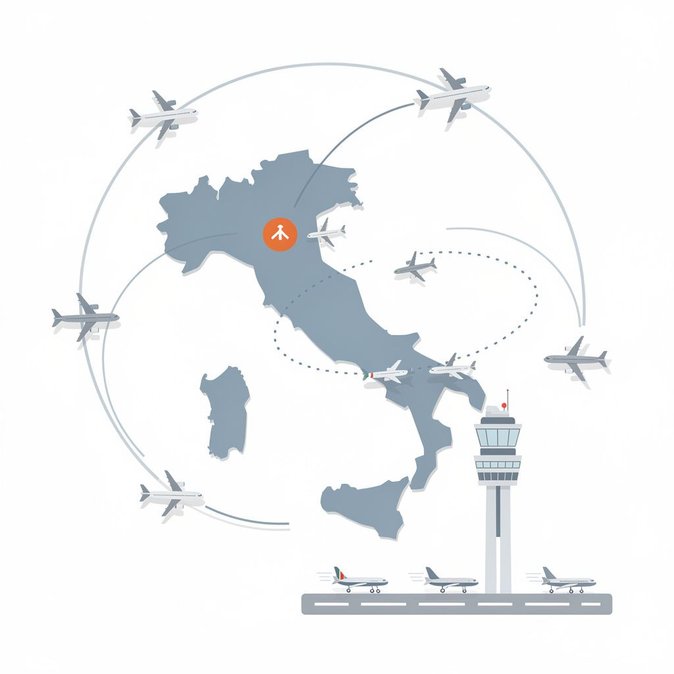
Good news and bad news for travellers: Italy’s four-hour nationwide air-traffic-control (ATC) strike planned for Saturday 21 November has been officially cancelled, but a local stoppage will still hit Milan Malpensa Airport tomorrow, Sunday 22 November, between 13:00 and 17:00. ENAV, the Italian ANSP, confirmed the change in a bulletin released at 09:49 on 21 November. The nationwide action—filed by the major aviation unions FILT-CGIL and UGL Trasporto Aereo—was expected to ground as many as 1,200 flights during one of the year’s busiest business-travel weekends. Its withdrawal followed eleventh-hour talks with the Ministry of Transport that secured a commitment to reopen negotiations on controller rostering and technology budgets. Airlines including ITA Airways and easyJet immediately restored previously trimmed schedules, although some rotations remained consolidated for operational reasons. Attention now turns to Malpensa, where the local union FAST-Confsal AV has maintained a four-hour tower strike over staffing levels and rest facilities. ENAV says all legally “protected” flights—medical, humanitarian and a core skeleton timetable—will operate, but advises passengers to check status before travelling. Business travellers connecting through Malpensa to Asian and North-American long-haul services should anticipate delays cascading throughout Sunday evening. Why it matters: with Rome hosting several high-profile investor conferences next week, Italy’s reliability as a gateway is under scrutiny. The fact that the national strike was called off shows social partners can find compromise, yet the Malpensa dispute highlights the vulnerability of single-airport bottlenecks. Multinationals moving staff in and out of northern Italy—home to 45 % of the country’s industrial output—should monitor further updates and prepare ground-transport options via Linate or Bergamo. Travellers booked on flights within the strike window who are delayed by more than three hours may be entitled to EU261 compensation, depending on whether the disruption is deemed ‘extraordinary’. Airlines are, however, obliged to provide care (meals, hotel, rerouting) irrespective of ultimate liability.
Source: Strike Tracker