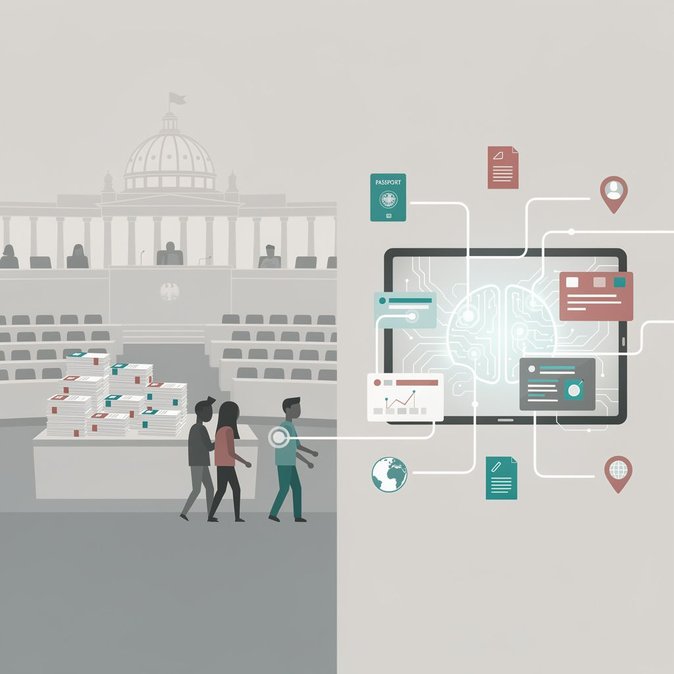
Germany’s Interior Committee will hold a high-profile public hearing on Monday, 23 November 2026, to scrutinise the federal government’s draft law on the “Deployment of Artificial Intelligence in Migration Administration” (KI-Migrationsverwaltungsgesetz, KIMVG). The Bundestag notice was published on 22 November and invites expert testimony from academics, civil-society groups and municipal immigration offices. The session will be livestreamed from the Paul-Löbe-Haus in Berlin. The KIMVG aims to modernise Germany’s fragmented immigration IT landscape by introducing AI-supported case-routing, risk-profiling and language-recognition modules across 500 Ausländerbehörden and the Federal Office for Migration and Refugees (BAMF). Proponents say automated triage could cut average processing times for work and family visas from the current 52 to 16 weeks and enable predictive staffing during seasonal peaks. The draft law earmarks €320 million for a six-year roll-out, financed through the federal digital fund. Civil-liberty advocates, however, warn of algorithmic bias and opaque decision-making. In written submissions released ahead of the hearing, the Gesellschaft für Freiheitsrechte calls for a statutory human-in-the-loop safeguard and a right to a “white-box explanation” when applications are rejected by AI pre-screening. Municipalities are more concerned about resources: the Association of German Cities notes that many local offices still run on decade-old software and lack the secure cloud connections required by the bill. For multinational employers the stakes are significant. Faster, more predictable processing would bolster Germany’s attractiveness under the revamped Skilled Immigration Act, particularly for STEM talent competing between EU hubs. But if the parliamentary debate dilutes data-sharing provisions—especially real-time links between Federal Police border systems and visa databases—companies may face a longer transitional phase with parallel paper and digital workflows. The Interior Committee will hear from nine experts, including AI ethicists, legal scholars and the CIO of Bavaria’s migration authority. A committee vote is expected in mid-December, with plenary adoption targeted for early 2027. HR mobility teams should monitor amendments closely, as the final text will define technical interface standards for employer portals and could mandate new data-protection clauses in global-mobility policies.
Source: Deutscher Bundestag