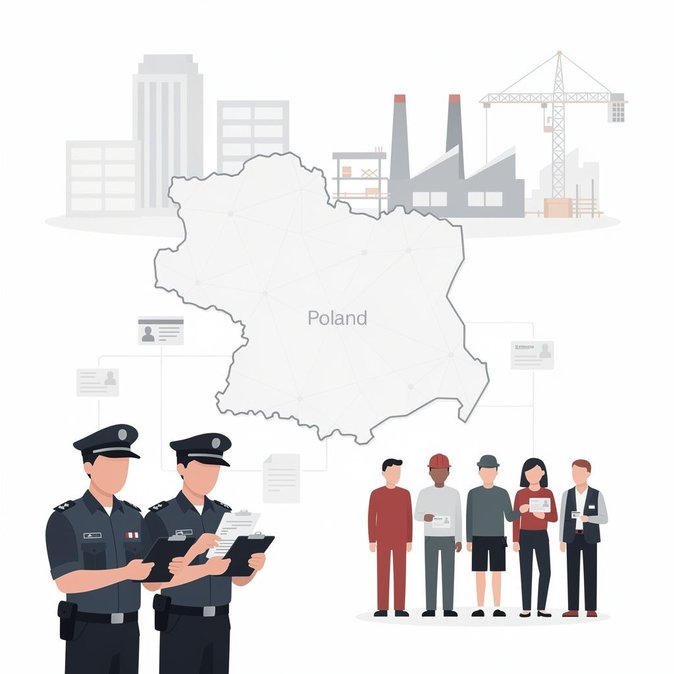
The Polish Border Guard (Straż Graniczna) has intensified spot-checks on the legality of foreigners’ stay and employment, culminating in a multi-agency operation code-named “Pobyt” that ran across several voivodships last week. According to official figures released on 22 November, officers examined the residence status of more than 1,400 people and detained over 80 on suspicion of illegal stay or work. Dozens now face administrative return orders and entry bans. Border Guard spokespersons say the sweeps were carried out jointly with the police, the National Fiscal Administration and labour inspectors. In the Silesian Voivodship alone, 191 foreigners were interviewed and 33 detained. Detainees came from Ukraine, India, Bangladesh, Colombia, the Philippines, Georgia and other countries, illustrating the growing diversity of Poland’s foreign workforce. Employers found to be using irregular labour face fines of PLN 3,000–50,000 and, in severe cases, criminal prosecution. Inspectors focused not only on residence titles, but also on whether actual duties matched work-permit declarations. Construction, manufacturing, catering and temporary-work agencies were the sectors with the highest non-compliance rates. Between January and October 2026, the Warmian-Masurian Border Guard district alone uncovered 700 cases of illegal employment during 2,900 checks. The crackdown follows a surge in document-forgery schemes. Investigators recently broke up a ring that “parked” money in applicants’ bank accounts to fabricate proof-of-funds letters; some 3,000 foreigners may have benefited. Authorities warn that forged invitations, counterfeit bank statements or misdeclared job duties can now trigger accelerated expulsion and multi-year Schengen-wide bans. For employers, the message is clear: audit your HR files, update posted-worker notifications and ensure that each foreign national’s PESEL and residence data remain current. For assignees and business travellers, carrying original documents and keeping employment contracts consistent with actual duties will be essential to avoid detention during random workplace visits.
Source: Odnoboko