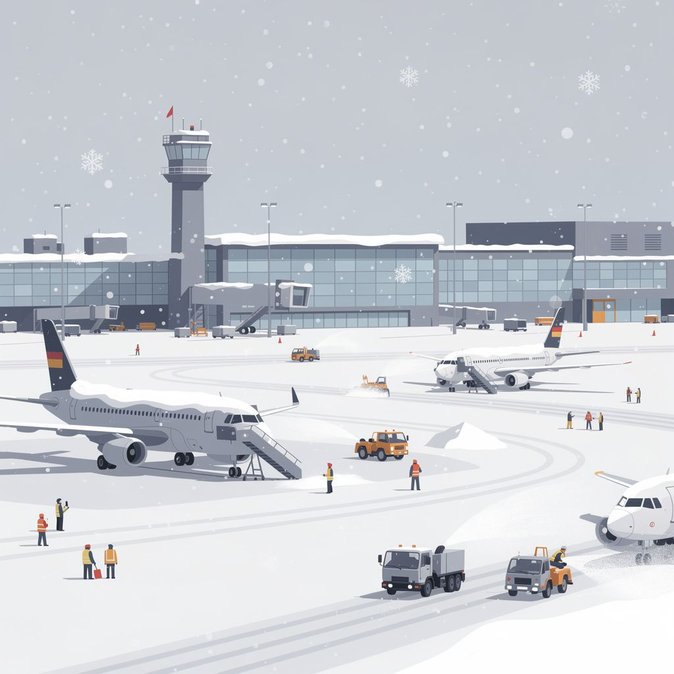
Austria’s first major snowstorm of the season hit Vienna International Airport (VIE) on Thursday night into Friday morning, snarling operations just as the pre-Advent travel rush was building. According to Austrian media, up to 9,000 Austrian Airlines customers had to be re-booked after heavy, wet snow forced ground handlers to stop almost every movement for prolonged periods while de-icing trucks cleared an unprecedented backlog. Runway and taxiway capacity was effectively halved because each aircraft needed an extensive anti-icing treatment. At the peak of the disruption, only 20 flight movements per hour were possible instead of the usual 40–60. One Airbus A320 operating flight OS431 to Valencia spent more than seven hours on the tarmac with passengers on board, and independent trackers logged at least 22 cancellations and dozens of multi-hour delays. Travellers to key business destinations such as Frankfurt, London and Tel Aviv all experienced knock-on delays, interrupting onward long-haul connections and time-critical cargo shipments. Airport operator Flughafen Wien AG deployed 500 staff and more than 100 specialist vehicles, but the sustained snowfall outpaced clearing operations. The airline has offered voluntary re-routing, hotel accommodation and EU-mandated compensation where applicable, yet the incident has reignited debate about Vienna Airport’s winter-resilience planning. Business-travel associations urged corporates to review contingency policies for staff transiting through the Central European hub during the peak December period, and logistics firms warned of possible back-logs in belly-hold freight if further storms occur. For globally mobile employees, the episode illustrates three practical points: 1) always supply up-to-date contact details so carriers can re-issue digital boarding passes automatically; 2) know EU Regulation 261/2004 rights to re-routing or reimbursement; and 3) build additional buffer time for Schengen entry stamp queues, which also lengthen when flights bunch together after weather holds. Employers with frequent Vienna routings may wish to contractually designate alternate hubs—Munich, Prague or Bratislava—as secondary gateways during the 2026/27 winter season. Meteorologists forecast sub-zero temperatures through the weekend, and authorities have retained orange weather alerts for Lower Austria. Further operational impacts remain possible, so travellers are advised to monitor airline apps and Austrian airport channels closely.