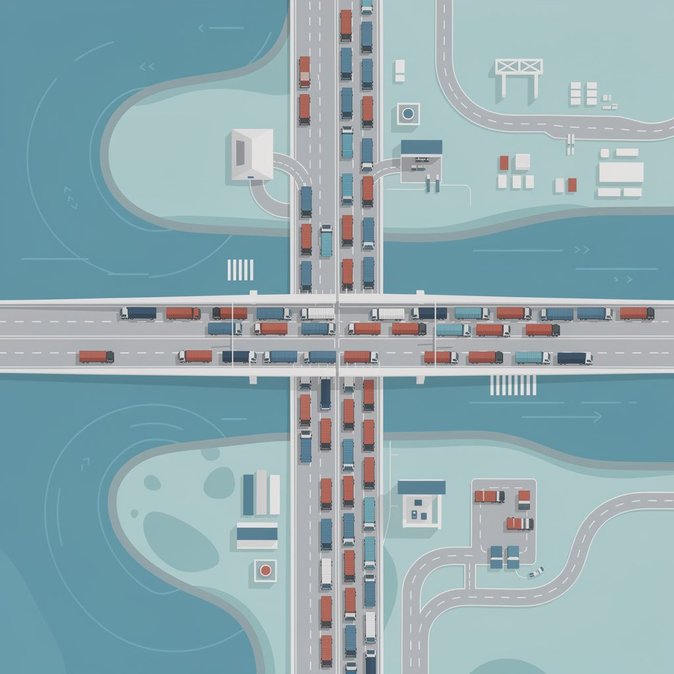
Satellite imagery analysed by NK News shows a marked rise in truck movements at the newly-opened New Yalu River Bridge linking Dandong, Liaoning, with Sinuiju in North Korea. Since the bridge’s official inauguration in mid-October, vehicle queues stretching across the span have become a daily occurrence, culminating in visible bottlenecks on 27 November as exporters raced to beat year-end quotas. The four-lane structure replaces the 1943 single-track Friendship Bridge—previously the only road-rail crossing on the 1,352-km frontier—and can handle 40-tonne articulated lorries, doubling previous axle-load limits. Chinese customs officials report that bilateral trade hit nearly US $300 million in September, and local authorities have already issued a 2.83-million-renminbi tender to upgrade traffic controls around the Dandong Border Economic Cooperation Zone. For global mobility managers the development matters in two ways. First, the re-opening of overland freight offers an alternative to the fragile Rajin port route, potentially stabilising supply chains for Chinese manufacturers employing North-Korean subcontractors. Second, customs clearance delays translate into unpredictable transit times for expatriate household goods and project cargo moving between Northeast China and the DPRK’s special zones. The uptick also raises compliance flags. United Nations sanctions still restrict a slew of dual-use items; companies must ensure logistics providers file the correct HS codes and retain proof-of-origin documentation. With long lines of trucks now idling on the bridge, random inspections are increasing—failure to present paperwork can lead to immediate seizure under China’s Export Control Law. Looking forward, Beijing has not announced plans to open the bridge to passenger traffic, but local tourism boards hope for controlled cross-border coach services by 2027. Until then, business travellers to North Korea will continue to rely on the Shenyang–Pyongyang air link or on charter buses scheduled around customs capacity. Either way, the bridge symbolises a slow but tangible normalisation of movement across Asia’s most tightly-guarded land border.
Source: NK News