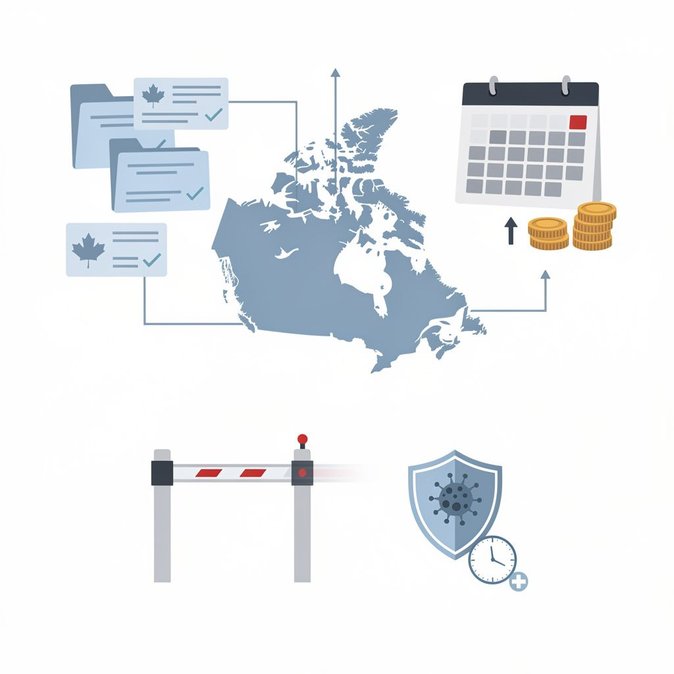
The Canada Border Services Agency (CBSA) has published draft amendments to the Presentation of Persons (2003) Regulations in the 28 November 2026 edition of the Canada Gazette, Part I. The 120-page Regulatory Impact Analysis Statement signals the biggest rewrite of Canada’s trusted-traveller framework in more than a decade, affecting CANPASS for corporate and private aircraft, NEXUS, the Commercial Driver Registration Program and related facilitation schemes at land, air and marine borders. At the heart of the proposal is the removal of the vague “good character” requirement that critics—including the Auditor General and Parliament’s Standing Joint Committee for the Scrutiny of Regulations—said was un-defined and prone to subjective interpretation. It would be replaced with an objective list of disqualifying factors—recent indictable convictions, outstanding warrants, national-security concerns, non-compliance with customs and immigration laws, and court orders to surrender travel documents. The agency also plans to write into the regulations an explicit duty for applicants to attend interviews with CBSA, RCMP or CSIS officers when requested. Other key changes aim to modernise the programmes for the realities of post-pandemic travel. Biometric requirements (fingerprints plus facial photo) that are already collected operationally will be codified. The time limit for members to appeal a suspension or cancellation would be extended from 30 to 90 days, bringing it into line with the Customs Act. Residency rules would be clarified so that only lawful residence in the specified countries counts toward the three-year eligibility threshold, closing a loophole that could allow irregular stay to qualify. For cross-border business travellers, the amendments promise more predictability when assessing eligibility and retaining membership—particularly valuable for executives shuttling between Canadian facilities and U.S. plants via NEXUS or CANPASS corporate aircraft. However, companies will need to audit employee records against the new disqualifying criteria and ensure that logistics suppliers understand the tighter reporting rules for private aircraft and pleasure craft. Once the comment period closes on 27 January 2027, CBSA expects to finalise the text later in 2027, giving travellers and employers several months to adapt training and compliance programmes. In the longer term, Ottawa hopes the clearer rules will increase uptake of low-risk traveller programmes and ease congestion at major land crossings such as Windsor-Detroit and Pacific Highway—critical arteries for Canada-U.S. supply chains—while preserving the security benefits that underpinned their creation after 9/11.
Source: Canada Gazette