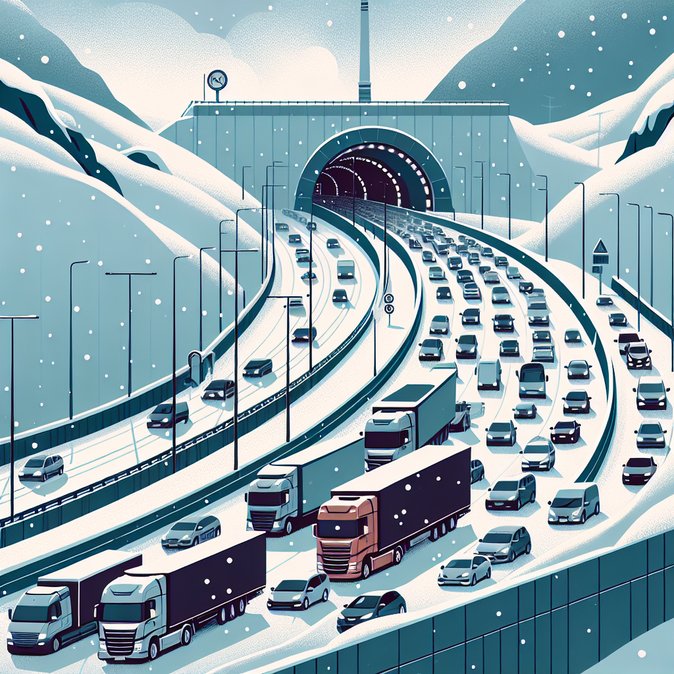
Holidaymakers heading south on 26 December 2025 found themselves trapped in one of the worst seasonal traffic jams in recent memory. According to the Touring Club Schweiz (TCS), queues in front of the Gotthard-Strassentunnel’s north portal stretched to six kilometres by midday, with motorists losing up to 90 minutes between Amsteg and Göschenen. By early afternoon the backlog had expanded to nine kilometres despite dynamic metering at the tunnel entrance and repeated radio warnings.
Christmas–New-Year week is traditionally the most critical period for Switzerland’s north–south artery, but this year’s volume is exacerbated by a perfect storm: pent-up demand for cross-border leisure trips after an autumn COVID-wave, rail capacity constrained by rolling-stock shortages, and a surge of foreign licence plates taking advantage of the strong Swiss franc for shopping tourism. The Federal Roads Office (ASTRA) is urging motorists not to exit the motorway to avoid the queue, citing safety risks for local communities and the higher accident rate on cantonal roads.
![Gotthard Tunnel Holiday Gridlock: Six-Kilometre Tailbacks Hit Switzerland’s Main North-South Corridor]()
For corporate mobility managers the jam is more than a holiday nuisance. The Gotthard corridor is the primary trucking route between Germany and Italy; delays ripple into just-in-time supply chains for Swiss exporters and slow down coach services contracted by multinationals to shuttle staff to Italian production sites. Logistics firms report rescheduling perishable loads via the San-Bernardino route (A13), but that detour adds 90 kilometres and is itself close to saturation.
Practical advice: ASTRA recommends planning departures outside peak windows (before 06:00 or after 20:00), monitoring the TCS live ticker, and considering rail car-shuttles through the Lötschberg or Vereina tunnels for vehicles bound for Valais or Graubünden. Companies with time-critical shipments should activate alternative routings or overnight storage south of the Alps until the backlog clears, expected around 2 January. Longer-term, the second Gotthard road tube, scheduled to open in 2030, should alleviate—but not eliminate—holiday bottlenecks.
Christmas–New-Year week is traditionally the most critical period for Switzerland’s north–south artery, but this year’s volume is exacerbated by a perfect storm: pent-up demand for cross-border leisure trips after an autumn COVID-wave, rail capacity constrained by rolling-stock shortages, and a surge of foreign licence plates taking advantage of the strong Swiss franc for shopping tourism. The Federal Roads Office (ASTRA) is urging motorists not to exit the motorway to avoid the queue, citing safety risks for local communities and the higher accident rate on cantonal roads.

For corporate mobility managers the jam is more than a holiday nuisance. The Gotthard corridor is the primary trucking route between Germany and Italy; delays ripple into just-in-time supply chains for Swiss exporters and slow down coach services contracted by multinationals to shuttle staff to Italian production sites. Logistics firms report rescheduling perishable loads via the San-Bernardino route (A13), but that detour adds 90 kilometres and is itself close to saturation.
Practical advice: ASTRA recommends planning departures outside peak windows (before 06:00 or after 20:00), monitoring the TCS live ticker, and considering rail car-shuttles through the Lötschberg or Vereina tunnels for vehicles bound for Valais or Graubünden. Companies with time-critical shipments should activate alternative routings or overnight storage south of the Alps until the backlog clears, expected around 2 January. Longer-term, the second Gotthard road tube, scheduled to open in 2030, should alleviate—but not eliminate—holiday bottlenecks.
Source: Blick (live traffic ticker)