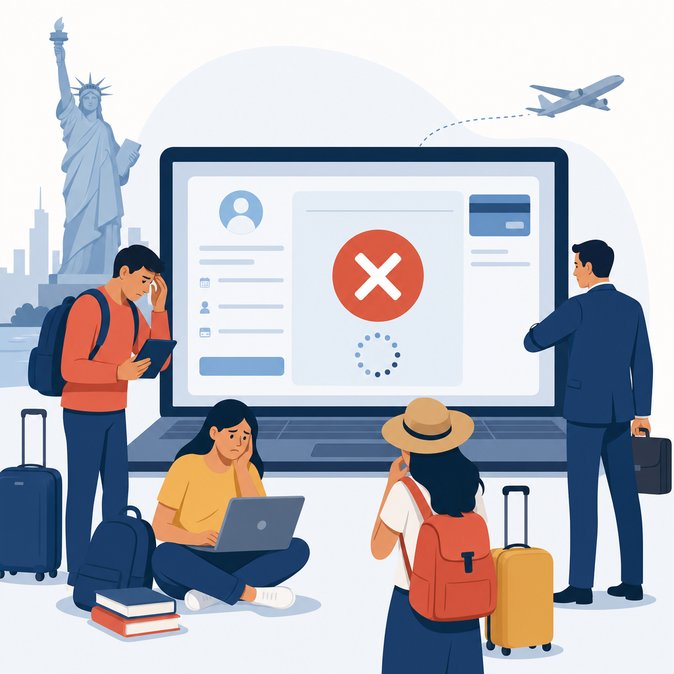
A global outage affecting USTravelDocs—the third-party website used by the US Department of State to collect visa fees and schedule consular interviews—has left Indian travellers unable to secure appointments or even pay processing charges. Business Standard first reported the disruption at 11 a.m. IST on 2 June 2026, noting that similar problems have appeared in Australia, Japan, Germany and Switzerland. Immigration firm Berry Appleman & Leiden says the outage has persisted “for weeks” but worsened as summer travel peaks and as students rush to obtain F-1 visas before the August semester. India is the world’s largest source of F-1 and H-1B applicants; more than 1.4 million visa transactions flowed through USTravelDocs’ India portal last fiscal year. With the site intermittently inaccessible, users see endless virtual “waiting rooms,” payment failures and blank dashboards, forcing many to restart applications from scratch. The impact is immediate for corporates: assignees awaiting B-1/B-2 or L-1 renewals risk missing conference dates and project kick-offs, while new hires abroad cannot report for US-based onboarding. Universities are advising incoming Indian students to watch for emergency slots and to budget extra time. Travel insurers report a spike in queries about “visa delay” cover. The US State Department said technicians are “working around the clock,” but offered no timeline for a fix. In the interim, applicants are urged not to refresh browsers repeatedly—doing so may lock accounts for 72 hours—and to retain all payment receipts to support refund claims if double-charged. Corporations with urgent travel needs are exploring discretionary interview-waiver requests under 22 CFR 41.102 but admit approvals are rare since waivers for most work and student categories lapsed in late 2025. Mobility teams should map critical assignments through at least mid-July, prepare alternative start dates, and warn business units that premium-processing approvals at USCIS do **not** override consular scheduling delays. Some employers are re-routing executives via Canada or the UK to secure L-1 Blanket appointments where capacity exists, albeit at higher cost.
Source: Business Standard