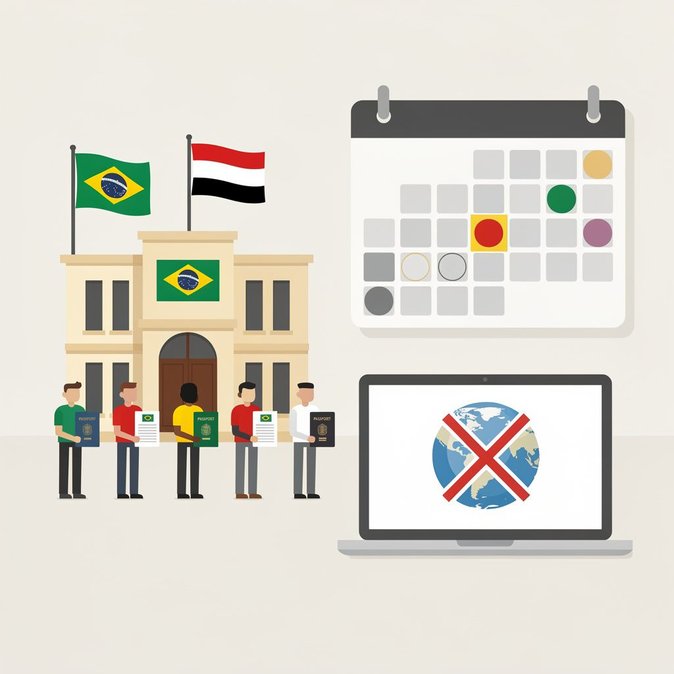
Brazil’s embassy in Cairo published an updated Arabic-language guide on 12 June 2026 confirming that ordinary Egyptian passport holders must apply in person for a visitor (VIVIS) visa and are not eligible for Brazil’s new electronic visa (eVisa) platform. The post, carried by regional travel portal Wego, corrects widespread social-media claims that Egypt would soon receive visa-free or eVisa access.
If the in-person process feels daunting, VisaHQ can streamline many of the preparatory steps: the agency’s Brazil desk (https://www.visahq.com/brazil/) pre-checks documentation, books Cairo consular appointments on your behalf and keeps applicants updated through a single online dashboard—saving valuable time as trade-show deadlines approach.
Under the current framework, only nationals of the United States, Canada and Australia can use the April 2025 eVisa scheme. All other travellers—including Egyptians heading to Brazil for tourism, short-term business meetings or trade shows—must book an appointment via the e-Consular system, upload supporting documents and attend biometrics capture at the Nile Corniche chancery. For Brazilian companies courting Middle-Eastern buyers ahead of São Paulo’s June trade-fair season, the clarification is critical: lead times for Cairo appointments are running three to four weeks, and consular processing may add another seven working days. Mobility managers should therefore adjust invitation timelines and budget for courier costs if originals are required. The embassy reiterated that diplomatic and service passport holders remain exempt from the visa requirement for stays up to 90 days, but warned that overstays could jeopardise future applications. It also reminded applicants that travel medical insurance is “strongly recommended” though not mandatory. Industry observers view the announcement as a signal that Brazil will expand—but not rush—the eVisa programme. Negotiations are understood to be under way with Gulf Cooperation Council states, yet the foreign ministry insists that system stability must be proven before adding high-volume markets such as Egypt or India.
If the in-person process feels daunting, VisaHQ can streamline many of the preparatory steps: the agency’s Brazil desk (https://www.visahq.com/brazil/) pre-checks documentation, books Cairo consular appointments on your behalf and keeps applicants updated through a single online dashboard—saving valuable time as trade-show deadlines approach.
Under the current framework, only nationals of the United States, Canada and Australia can use the April 2025 eVisa scheme. All other travellers—including Egyptians heading to Brazil for tourism, short-term business meetings or trade shows—must book an appointment via the e-Consular system, upload supporting documents and attend biometrics capture at the Nile Corniche chancery. For Brazilian companies courting Middle-Eastern buyers ahead of São Paulo’s June trade-fair season, the clarification is critical: lead times for Cairo appointments are running three to four weeks, and consular processing may add another seven working days. Mobility managers should therefore adjust invitation timelines and budget for courier costs if originals are required. The embassy reiterated that diplomatic and service passport holders remain exempt from the visa requirement for stays up to 90 days, but warned that overstays could jeopardise future applications. It also reminded applicants that travel medical insurance is “strongly recommended” though not mandatory. Industry observers view the announcement as a signal that Brazil will expand—but not rush—the eVisa programme. Negotiations are understood to be under way with Gulf Cooperation Council states, yet the foreign ministry insists that system stability must be proven before adding high-volume markets such as Egypt or India.