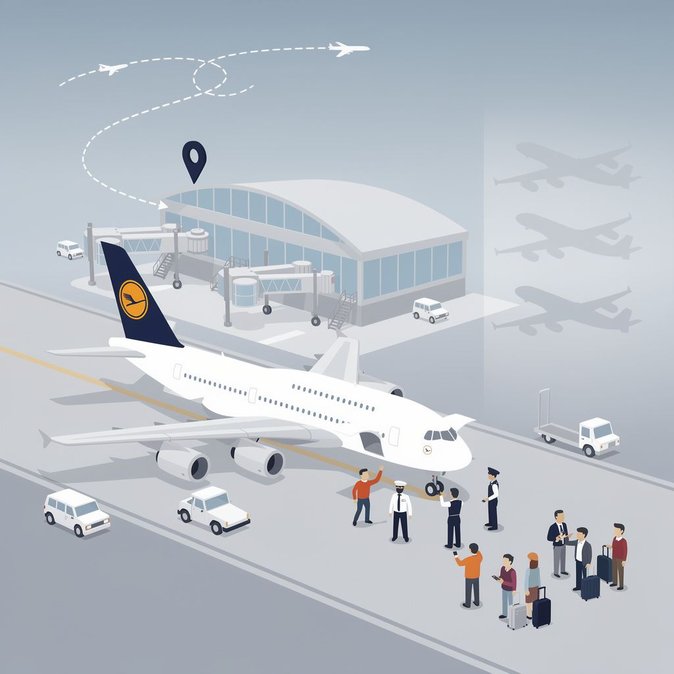
Lufthansa flight LH459 from San Francisco to Munich – a 508-seat Airbus A380 – diverted to Boston on 11 June after a passenger allegedly assaulted a seatmate over central Canada. Massachusetts State Police removed the individual; the aircraft refuelled and landed in Munich roughly 13 hours behind schedule. For mobility planners the knock-on effects matter more than the headline. The diversion pulled one of only eight A380s in Lufthansa’s long-haul roster off schedule, forcing equipment swaps on Thursday and Friday’s transatlantic rotations. Travellers booked on the flagship morning services LH458/459 and LH410/411 (Munich–San Francisco / New York) should expect potential aircraft changes and shorter check-in deadlines while crew-duty limits reset.
During such unexpected itinerary shifts, ensuring that all travellers possess the correct documentation for alternative routings or extended stays becomes critical. VisaHQ’s online platform (https://www.visahq.com/germany/) can rapidly verify visa requirements, process e-visas, and arrange transit permits for Germany and other jurisdictions, helping travel managers keep displaced employees compliant and mobile when flights are disrupted.
EU261/2004 compensation is unlikely because unruly-passenger incidents are deemed ‘extraordinary circumstances’, but Lufthansa remains liable for care obligations. Travel managers should proactively issue letters for duty-of-care insurance claims covering hotel costs in Munich or Frankfurt for missed connections. The incident also underscores a regulatory trend: EASA is finalising guidance that could mandate airlines to carry non-lethal restraint kits on long-haul flights. Carriers operating from Germany’s hubs may face new crew-training costs. With the Football World Cup driving peak demand, any wide-body disruption at Munich magnifies capacity constraints. Companies moving project teams this weekend should monitor flight status and consider routings via Frankfurt or Zurich.
During such unexpected itinerary shifts, ensuring that all travellers possess the correct documentation for alternative routings or extended stays becomes critical. VisaHQ’s online platform (https://www.visahq.com/germany/) can rapidly verify visa requirements, process e-visas, and arrange transit permits for Germany and other jurisdictions, helping travel managers keep displaced employees compliant and mobile when flights are disrupted.
EU261/2004 compensation is unlikely because unruly-passenger incidents are deemed ‘extraordinary circumstances’, but Lufthansa remains liable for care obligations. Travel managers should proactively issue letters for duty-of-care insurance claims covering hotel costs in Munich or Frankfurt for missed connections. The incident also underscores a regulatory trend: EASA is finalising guidance that could mandate airlines to carry non-lethal restraint kits on long-haul flights. Carriers operating from Germany’s hubs may face new crew-training costs. With the Football World Cup driving peak demand, any wide-body disruption at Munich magnifies capacity constraints. Companies moving project teams this weekend should monitor flight status and consider routings via Frankfurt or Zurich.