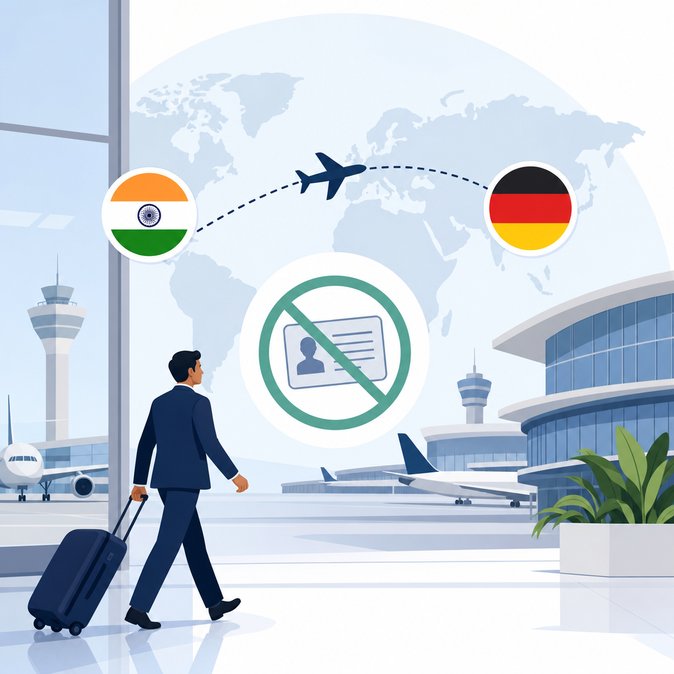
Germany has officially abolished the Airport Transit Visa (ATV) requirement for Indian passport-holders who simply change planes at German hubs such as Frankfurt, Munich, Berlin or Düsseldorf on their way to a third country. The measure was published in the Bundesgesetzblatt (Federal Law Gazette) on 2 June 2026 and entered into force just after midnight on 3 June 2026. According to the German Embassy in New Delhi, Indian passengers may now remain in the international transit zone for up to 24 hours without any visa formalities, provided they continue to a non-Schengen destination and do not pass through immigration. The decision fulfils a pledge made during Chancellor Friedrich Merz’s state visit to India in January 2026 and signals closer economic and political ties. For Germany’s airports and flag-carrier Lufthansa—whose route network relies heavily on long-haul connections—the removal of the paperwork barrier is expected to boost through-ticket sales from India, one of the world’s fastest-growing outbound markets. Airlines and travel-management companies are already updating booking engines to flag Germany as a visa-free transfer option alongside hubs such as Doha and Istanbul. From a mobility-management perspective, the change eliminates an administrative hurdle that often caught business travellers off-guard. Under the old rules, Indian executives transiting Frankfurt en route to North America, Latin America or Africa had to secure a Type-A Schengen ATV, submit biometrics and pay a €80 fee—sometimes forcing costly rerouting at short notice. Corporate travel teams can now widen preferred-carrier agreements and negotiate more aggressive volume discounts on Lufthansa Group fares. The wider impact reaches beyond aviation. Germany hosts more than 200 Indian subsidiaries and research centres; many fly in technical staff on tight timelines to support projects elsewhere in Europe or the United States. Faster, visa-free transfers reduce down-time and give project managers added scheduling flexibility. Mobility specialists should nevertheless remind assignees that the exemption does not permit entry into Germany; anyone wishing to leave the airport still needs the appropriate Schengen or national visa. Indian authorities welcomed the move. External-Affairs spokesperson Randhir Jaiswal said on X that the waiver will “enhance people-to-people ties and strengthen economic linkages”. Travel agents in Delhi and Mumbai report a spike in enquiries for itineraries that use Frankfurt or Munich as a mid-journey stop. German airports anticipate higher passenger throughput and have stepped up multilingual signage in transit zones to ease the flow.
Source: NDTV Travel