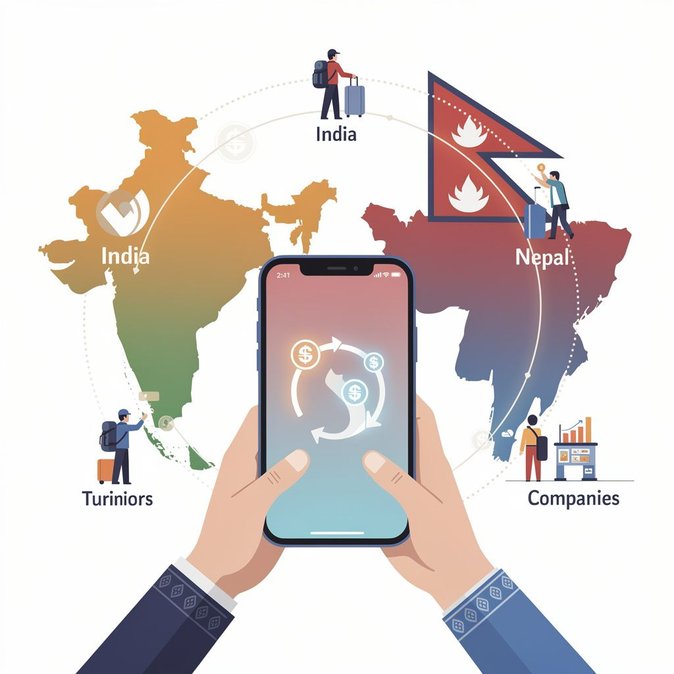
India and Nepal quietly flipped the switch on a new peer-to-peer remittance link between India’s Unified Payments Interface (UPI) and Nepal’s National Payments Interface (NPI) on 6 June, and the Indian finance ministry formally announced the launch on 11 June. The system allows residents of the two countries to send up to NPR 100,000 (about ₹62,000) instantly via mobile apps without SWIFT charges or cash-exchange hassles.
Travellers planning to take advantage of the new corridor should also remember that they still need valid travel documents. VisaHQ, an online visa and passport services platform, can streamline the process of obtaining or renewing an Indian visa—or any other documents required for multi-country itineraries—before you hop on a bus to Kathmandu. Its India portal (https://www.visahq.com/india/) walks applicants through e-visa eligibility, photo specs and processing times, with live-chat assistance that cuts down on paperwork errors.
For the two million Indian citizens who cross into Nepal annually—and the estimated 600,000 Nepalese working in India—the corridor eliminates a major pain-point: carrying wads of cash or searching for money-transfer kiosks that levy fees as high as 7 percent. Travellers can now scan any QR code that accepts NPI or UPI and pay in local currency with realtime FX conversion at inter-bank rates, improving expense management for short-term assignees, aid workers and mountaineering groups. NPCI International Payments Ltd (NIPL) built the interface with Nepal Clearing House Ltd; the pilot partners are India’s Axis Bank and Nepal’s Global IME Bank, with others slated to onboard within weeks. Merchants in Kathmandu’s Thamel district report a jump in Indian QR payments for hotel deposits, mirroring the uptake seen when UPI went live in Bhutan in 2025. From a compliance standpoint, transactions are capped at ₹1 lakh per user per day and are covered by India’s Liberalised Remittance Scheme reporting rules. Corporate finance teams should update travel-expense policies to allow employees to use personal UPI apps in Nepal—but remind them to retain screenshot receipts, as paper slips are no longer issued. NIPL says similar cross-border corridors with Sri Lanka and Mauritius will go live later this year, signalling that South Asia’s mobility ecosystem is moving toward a cash-light, QR-first model.
Travellers planning to take advantage of the new corridor should also remember that they still need valid travel documents. VisaHQ, an online visa and passport services platform, can streamline the process of obtaining or renewing an Indian visa—or any other documents required for multi-country itineraries—before you hop on a bus to Kathmandu. Its India portal (https://www.visahq.com/india/) walks applicants through e-visa eligibility, photo specs and processing times, with live-chat assistance that cuts down on paperwork errors.
For the two million Indian citizens who cross into Nepal annually—and the estimated 600,000 Nepalese working in India—the corridor eliminates a major pain-point: carrying wads of cash or searching for money-transfer kiosks that levy fees as high as 7 percent. Travellers can now scan any QR code that accepts NPI or UPI and pay in local currency with realtime FX conversion at inter-bank rates, improving expense management for short-term assignees, aid workers and mountaineering groups. NPCI International Payments Ltd (NIPL) built the interface with Nepal Clearing House Ltd; the pilot partners are India’s Axis Bank and Nepal’s Global IME Bank, with others slated to onboard within weeks. Merchants in Kathmandu’s Thamel district report a jump in Indian QR payments for hotel deposits, mirroring the uptake seen when UPI went live in Bhutan in 2025. From a compliance standpoint, transactions are capped at ₹1 lakh per user per day and are covered by India’s Liberalised Remittance Scheme reporting rules. Corporate finance teams should update travel-expense policies to allow employees to use personal UPI apps in Nepal—but remind them to retain screenshot receipts, as paper slips are no longer issued. NIPL says similar cross-border corridors with Sri Lanka and Mauritius will go live later this year, signalling that South Asia’s mobility ecosystem is moving toward a cash-light, QR-first model.