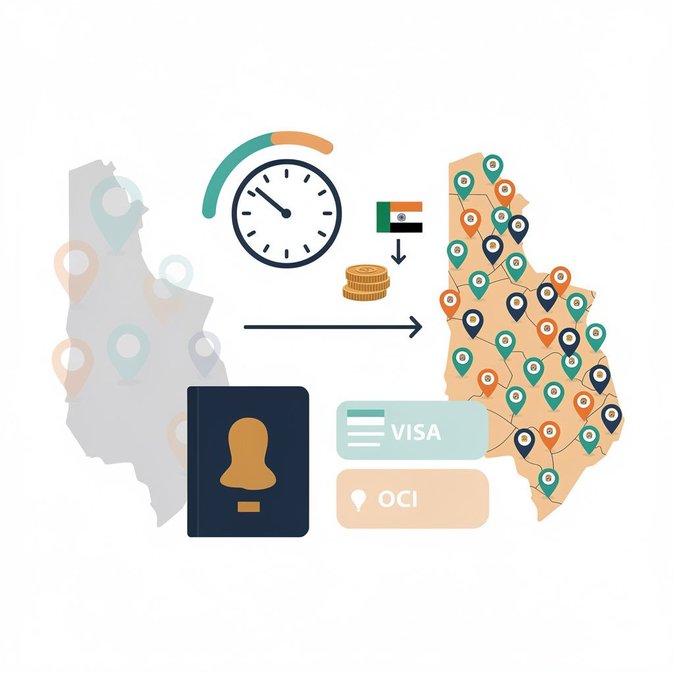
Indian families hoping to secure permanent US residence through the Employment-Based Fifth Preference (EB-5) programme have just been hit with an unexpected summer pause. On 10 June the US Department of State quietly confirmed that every one of the 3,200 ‘unreserved’ EB-5 visa numbers set aside for Indian nationals in FY 2026 has been used up—five months before the fiscal year ends on 30 September. As a result, US embassies and consulates worldwide have been ordered to stop issuing fresh immigrant visas in the C5, T5, I5, R5, RU and NU categories to Indian applicants. Processing can continue behind the scenes, but no new visas will be stamped until allocations reset on 1 October 2026.
At this juncture, many families turn to specialised visa services for up-to-date guidance. VisaHQ’s India office (https://www.visahq.com/india/) can help investors monitor appointment availability, maintain compliant documentation and explore alternative immigration channels while the EB-5 pause is in effect, streamlining paperwork so that cases move swiftly once numbers are released again.
The unreserved pool represents the lion’s share of EB-5 numbers and is distinct from smaller ‘reserved’ sub-categories created under the EB-5 Reform and Integrity Act of 2022. Demand from India—already the world’s second-largest EB-5 market after China—accelerated sharply this spring as wealthy families sought an alternative to long H-1B and family-based green-card backlogs. Advisers say many investors filed applications based on projects in rural and high-unemployment areas to qualify for lower minimum investments of US $800,000, further fuelling uptake. Although the cap is a mechanical quota rather than a policy decision targeting India, the freeze still disrupts planning for companies that use EB-5 to relocate executives, for students timing US university starts, and for mobility managers creating succession plans for senior employees. Lawyers stress that filed petitions remain in the queue and that applicants should keep their financial documentation, source-of-funds evidence and police clearances valid so that interview scheduling can resume quickly after 1 October. For Indian businesses the episode is a reminder that country caps apply to all employment-based green-card categories. If demand continues to surge, observers expect the State Department to advance ‘retrogression’ dates in the monthly visa bulletin—effectively creating a waiting list for future Indian EB-5 investors even after the new fiscal year opens. Mobility teams are therefore advising C-suite applicants to budget at least an extra six to nine months in their relocation timelines, and to consider parallel destinations such as Portugal’s Golden Visa or the UAE Golden Visa for children’s education continuity.
At this juncture, many families turn to specialised visa services for up-to-date guidance. VisaHQ’s India office (https://www.visahq.com/india/) can help investors monitor appointment availability, maintain compliant documentation and explore alternative immigration channels while the EB-5 pause is in effect, streamlining paperwork so that cases move swiftly once numbers are released again.
The unreserved pool represents the lion’s share of EB-5 numbers and is distinct from smaller ‘reserved’ sub-categories created under the EB-5 Reform and Integrity Act of 2022. Demand from India—already the world’s second-largest EB-5 market after China—accelerated sharply this spring as wealthy families sought an alternative to long H-1B and family-based green-card backlogs. Advisers say many investors filed applications based on projects in rural and high-unemployment areas to qualify for lower minimum investments of US $800,000, further fuelling uptake. Although the cap is a mechanical quota rather than a policy decision targeting India, the freeze still disrupts planning for companies that use EB-5 to relocate executives, for students timing US university starts, and for mobility managers creating succession plans for senior employees. Lawyers stress that filed petitions remain in the queue and that applicants should keep their financial documentation, source-of-funds evidence and police clearances valid so that interview scheduling can resume quickly after 1 October. For Indian businesses the episode is a reminder that country caps apply to all employment-based green-card categories. If demand continues to surge, observers expect the State Department to advance ‘retrogression’ dates in the monthly visa bulletin—effectively creating a waiting list for future Indian EB-5 investors even after the new fiscal year opens. Mobility teams are therefore advising C-suite applicants to budget at least an extra six to nine months in their relocation timelines, and to consider parallel destinations such as Portugal’s Golden Visa or the UAE Golden Visa for children’s education continuity.