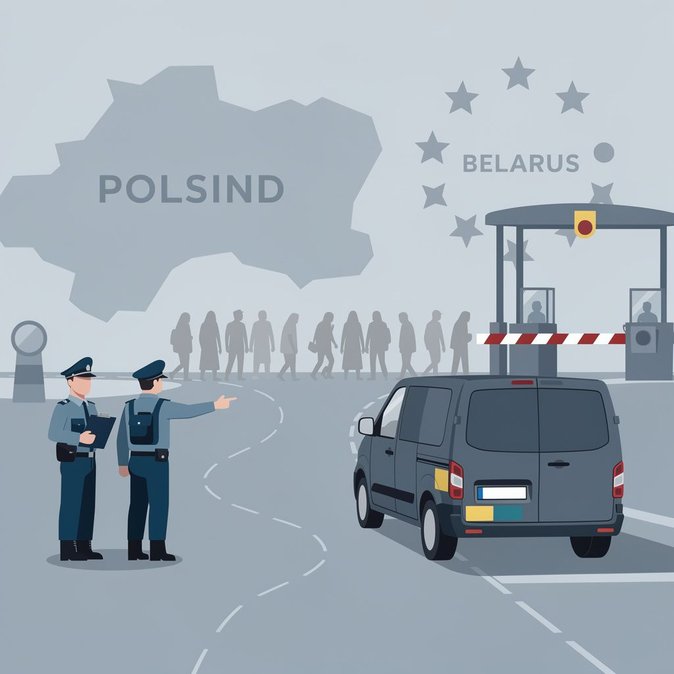
The Nadbużański Border Guard announced on 12 June that a 27-year-old Ukrainian national was expelled after investigators established his role in transporting groups that had crossed the Belarus–Poland border illegally. Acting under prosecutorial supervision, officers intercepted the man near Biała Podlaska where he was waiting to pick up migrants and drive them westward for fees of up to €2 000 per person. Authorities deemed the individual a threat to public order and issued a six-year entry ban covering the entire Schengen Area.
In light of these tightened controls, travelers and corporate transport managers can simplify visa compliance through VisaHQ, which provides real-time guidance on Poland’s entry requirements, Schengen visa processing, and document renewal services, all accessible online at https://www.visahq.com/poland/
The case illustrates Poland’s shift toward immediate administrative removal rather than lengthy criminal trials in lower-level smuggling incidents, freeing investigative resources to pursue larger networks believed to be orchestrated from Minsk and Moscow. For logistics firms operating near the so-called ‘bug corridor’, the incident is a warning that company vehicles and ride-sharing platforms can be co-opted for smuggling. Compliance officers should retrain drivers on vehicle-rental vetting and instruct them to report suspicious pick-up requests in wooded zones. The deportation also triggers mandatory data-sharing with EUROPOL under the new pact, meaning transport-pattern analysis will feed into EU risk profiles. Mobility consultants anticipate that passenger-van rentals within 30 km of the eastern border will face enhanced due-diligence checks this summer. Meanwhile, NGOs underscore the humanitarian dimension, noting that clandestine crossings often involve asylum seekers denied the chance to lodge claims at official checkpoints since the 2021 hybrid-pressure crisis with Belarus.
In light of these tightened controls, travelers and corporate transport managers can simplify visa compliance through VisaHQ, which provides real-time guidance on Poland’s entry requirements, Schengen visa processing, and document renewal services, all accessible online at https://www.visahq.com/poland/
The case illustrates Poland’s shift toward immediate administrative removal rather than lengthy criminal trials in lower-level smuggling incidents, freeing investigative resources to pursue larger networks believed to be orchestrated from Minsk and Moscow. For logistics firms operating near the so-called ‘bug corridor’, the incident is a warning that company vehicles and ride-sharing platforms can be co-opted for smuggling. Compliance officers should retrain drivers on vehicle-rental vetting and instruct them to report suspicious pick-up requests in wooded zones. The deportation also triggers mandatory data-sharing with EUROPOL under the new pact, meaning transport-pattern analysis will feed into EU risk profiles. Mobility consultants anticipate that passenger-van rentals within 30 km of the eastern border will face enhanced due-diligence checks this summer. Meanwhile, NGOs underscore the humanitarian dimension, noting that clandestine crossings often involve asylum seekers denied the chance to lodge claims at official checkpoints since the 2021 hybrid-pressure crisis with Belarus.