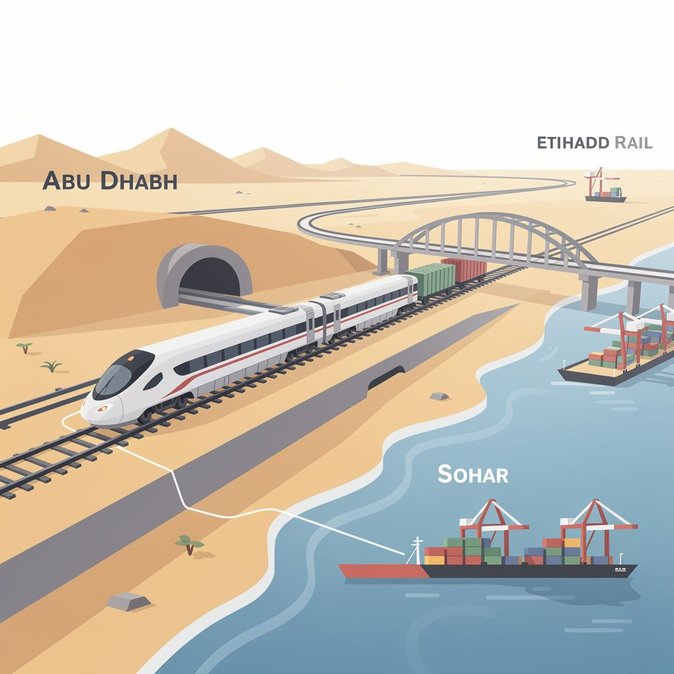
The US $2.5 billion Hafeet Rail project—jointly owned by Etihad Rail, Oman Rail and Mubadala—has crossed the 40 percent construction milestone, according to a progress update released on 12 June. Spanning 238 km from Abu Dhabi’s Al Wathba junction to Oman’s Sohar Port, the line will carry both 200 km/h passenger services and heavy freight trains. Engineers have already moved 27 million m³ of earth, poured 100,000 m³ of concrete and begun erecting 60 bridges and 2.5 km of mountain tunnels. Work is under way simultaneously at Al Ain, Al Buraimi, Wadi Al Jizzi and Sohar, aided by an integrated flood-protection design to cope with wadis. The consortium reports more than 10 million man-hours without a lost-time injury, underscoring the UAE’s focus on high-safety rail delivery. Once operational, passenger trains will whisk travellers from Abu Dhabi to Sohar in 100 minutes and from Al Ain to Sohar in just 47 minutes, slashing current road journeys by two-thirds. For logistics planners, the rail link will connect five major Gulf ports, 15 freight terminals and Etihad Rail’s domestic network, enabling door-to-door land-bridge solutions that bypass Strait-of-Hormuz shipping risks. Free-zone managers anticipate a surge in cross-border warehousing and light-industrial investment along the corridor, while tour operators already market weekend seafood runs to Sohar’s Corniche. HR teams arranging rotational staff between UAE and Oman projects should factor rail into 2027 duty-of-care planning; Etihad Rail says passport and biometric checks will be completed on-board to avoid station bottlenecks. The update comes as GCC ministers prepare to finalise standards for the region-wide rail interoperability framework, meaning Hafeet may later plug into a unified ticketing system covering Saudi Arabia and Qatar.
Source: International Finance