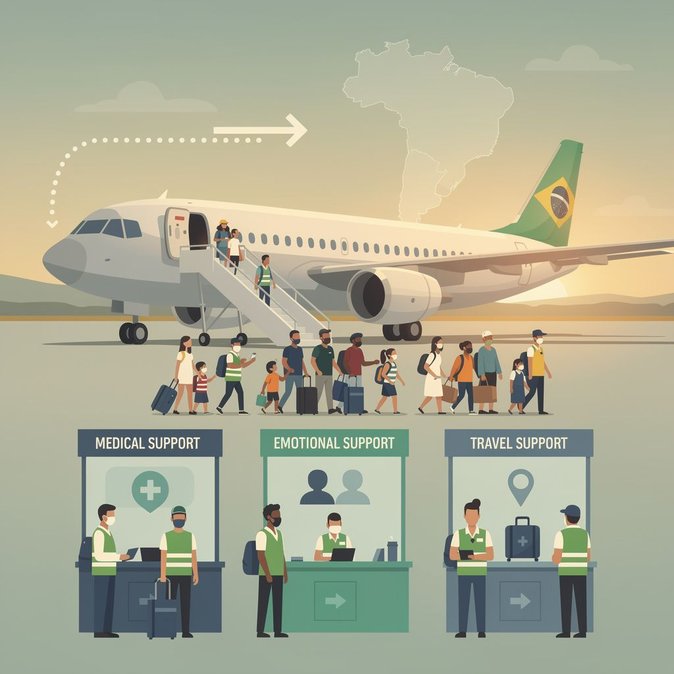
A charter flight from Houston touched down at Belo Horizonte/Confins International Airport shortly before 19:30 on Thursday, 11 June, carrying 62 Brazilians who had been deported after irregular stays in the United States. Within minutes of arrival the passengers were received by an inter-ministerial task-force under the humanitarian repatriation scheme ‘Aqui é Brasil’, coordinated by the Ministry of Human Rights and Citizenship (MDHC) with the support of the Foreign Ministry, the Justice Ministry, the Health Ministry, the Social Development Ministry, the Federal Police and the International Organization for Migration (IOM).
For Brazilians looking to prevent such ordeals in the first place, VisaHQ offers a streamlined way to secure the correct U.S. visas and other travel documents online. Through its Brazil portal (https://www.visahq.com/brazil/), the service provides up-to-date requirements, document checks and courier support, helping travellers avoid irregular crossings and the legal complications that led many of Thursday’s returnees to deportation.
Inside a dedicated arrivals hall decorated with festa-junina bunting, the returnees underwent biometric registration, received hygiene kits, hot meals and medical triage. Seven passengers were referred directly to hospital for chronic conditions aggravated during detention in U.S. facilities; the remaining 55 were offered overnight lodging and onward tickets to their home states. Thirteen opted to depart immediately after relatives drove to Confins to meet them—an emotional reunion highlighted by programme coordinators as evidence of "family reintegration in practice". According to Mariana Medeiros, head of the Confins reception cell, most of Thursday’s group were single men aged 18-29 who had crossed Mexico’s Darién route in late 2025 before being detained by U.S. Border Patrol. “Many arrive with nothing more than a plastic bag containing their court papers,” she told reporters, stressing that psychological first-aid and migration counselling are as important as food and shelter. Since January, ‘Aqui é Brasil’ has run 19 reception operations, helping 1,204 nationals expelled from the U.S., Mexico and Caribbean states. The programme was created in 2023 amid a spike in deportations of Brazilians attempting irregular entry into North America. It offers 72 hours of comprehensive assistance—transport, accommodation, emergency cash grants and job-centre referrals—before handing cases to municipal welfare agencies. Business-mobility managers should note that the government is now exploring public-private partnerships to finance onward travel, potentially opening sponsorship opportunities for employers facing labour shortages in interior regions. Diplomatically, the operation underscores Brasília’s balancing act: it maintains consular cooperation with Washington while signalling that the Lula administration will continue to discourage risky migration routes and invest in domestic reintegration. Multinationals may wish to incorporate the repatriation calendar into corporate social-responsibility planning, particularly in sectors — construction, agribusiness, hospitality — that frequently re-absorb return migrants.

For Brazilians looking to prevent such ordeals in the first place, VisaHQ offers a streamlined way to secure the correct U.S. visas and other travel documents online. Through its Brazil portal (https://www.visahq.com/brazil/), the service provides up-to-date requirements, document checks and courier support, helping travellers avoid irregular crossings and the legal complications that led many of Thursday’s returnees to deportation.
Inside a dedicated arrivals hall decorated with festa-junina bunting, the returnees underwent biometric registration, received hygiene kits, hot meals and medical triage. Seven passengers were referred directly to hospital for chronic conditions aggravated during detention in U.S. facilities; the remaining 55 were offered overnight lodging and onward tickets to their home states. Thirteen opted to depart immediately after relatives drove to Confins to meet them—an emotional reunion highlighted by programme coordinators as evidence of "family reintegration in practice". According to Mariana Medeiros, head of the Confins reception cell, most of Thursday’s group were single men aged 18-29 who had crossed Mexico’s Darién route in late 2025 before being detained by U.S. Border Patrol. “Many arrive with nothing more than a plastic bag containing their court papers,” she told reporters, stressing that psychological first-aid and migration counselling are as important as food and shelter. Since January, ‘Aqui é Brasil’ has run 19 reception operations, helping 1,204 nationals expelled from the U.S., Mexico and Caribbean states. The programme was created in 2023 amid a spike in deportations of Brazilians attempting irregular entry into North America. It offers 72 hours of comprehensive assistance—transport, accommodation, emergency cash grants and job-centre referrals—before handing cases to municipal welfare agencies. Business-mobility managers should note that the government is now exploring public-private partnerships to finance onward travel, potentially opening sponsorship opportunities for employers facing labour shortages in interior regions. Diplomatically, the operation underscores Brasília’s balancing act: it maintains consular cooperation with Washington while signalling that the Lula administration will continue to discourage risky migration routes and invest in domestic reintegration. Multinationals may wish to incorporate the repatriation calendar into corporate social-responsibility planning, particularly in sectors — construction, agribusiness, hospitality — that frequently re-absorb return migrants.