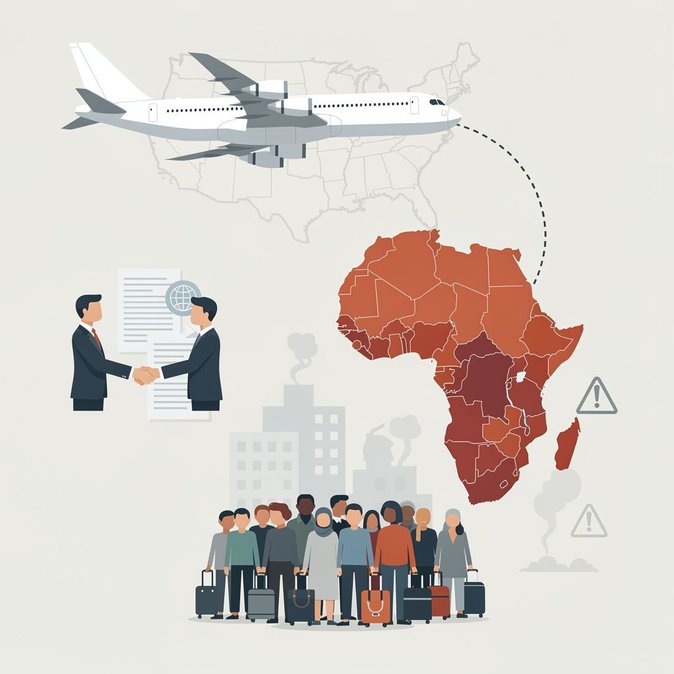
In the early hours of 12 June a chartered Boeing 767 from Alexandria, Louisiana touched down in Bangui, Central African Republic (CAR), carrying roughly 20 migrants—among them two Iranian women, plus Turkish, Syrian and Afghan nationals—who had been ordered removed by U.S. immigration judges. The flight is the first under a little-publicised agreement signed last month between Washington and the CAR, making the conflict-scarred nation the sixth African state to accept U.S. deportees since 2025. Rights groups call the transfers reckless. The U.S. State Department’s own travel advisory lists CAR at Level 4 (“Do Not Travel”) due to armed conflict and crime.
Amid such uncertainty, VisaHQ can streamline the practical side of contingency planning by securing the necessary visas, travel documents, and up-to-date advisories for personnel who must still enter or transit the United States or third-country destinations. Through its U.S. portal (https://www.visahq.com/united-states/), the firm provides real-time guidance on documentation requirements and risk ratings, allowing employers and NGOs to make informed decisions before deployment.
Nevertheless, DHS argues that third-country resettlement deals are vital to overcoming diplomatic impasses that prevent deportations to countries such as Iran and Syria. For corporate mobility planners, the policy has dual implications. First, foreign nationals who once hoped asylum claims would block removal may now face transfer to a third country rather than release in the U.S., increasing the stakes of due-process advocacy. Second, employers with operations in high-risk jurisdictions like CAR must reassess security protocols as the arrival of deportees may strain local resources and heighten instability. The opaque nature of the deal—no text has been published, and neither government has revealed what financial incentives are involved—also raises compliance questions for organisations that contract with U.S. agencies to provide post-removal services. The International Organization for Migration will reportedly supply initial assistance, backed by $85 million in U.S. funding. Finally, the move signals the administration’s expanding toolkit for expedited removals. Similar agreements are said to be pending with additional African nations, suggesting that third-country deportations could soon become a standard feature of U.S. immigration enforcement, reshaping risk assessments for humanitarian and corporate stakeholders alike.
Amid such uncertainty, VisaHQ can streamline the practical side of contingency planning by securing the necessary visas, travel documents, and up-to-date advisories for personnel who must still enter or transit the United States or third-country destinations. Through its U.S. portal (https://www.visahq.com/united-states/), the firm provides real-time guidance on documentation requirements and risk ratings, allowing employers and NGOs to make informed decisions before deployment.
Nevertheless, DHS argues that third-country resettlement deals are vital to overcoming diplomatic impasses that prevent deportations to countries such as Iran and Syria. For corporate mobility planners, the policy has dual implications. First, foreign nationals who once hoped asylum claims would block removal may now face transfer to a third country rather than release in the U.S., increasing the stakes of due-process advocacy. Second, employers with operations in high-risk jurisdictions like CAR must reassess security protocols as the arrival of deportees may strain local resources and heighten instability. The opaque nature of the deal—no text has been published, and neither government has revealed what financial incentives are involved—also raises compliance questions for organisations that contract with U.S. agencies to provide post-removal services. The International Organization for Migration will reportedly supply initial assistance, backed by $85 million in U.S. funding. Finally, the move signals the administration’s expanding toolkit for expedited removals. Similar agreements are said to be pending with additional African nations, suggesting that third-country deportations could soon become a standard feature of U.S. immigration enforcement, reshaping risk assessments for humanitarian and corporate stakeholders alike.