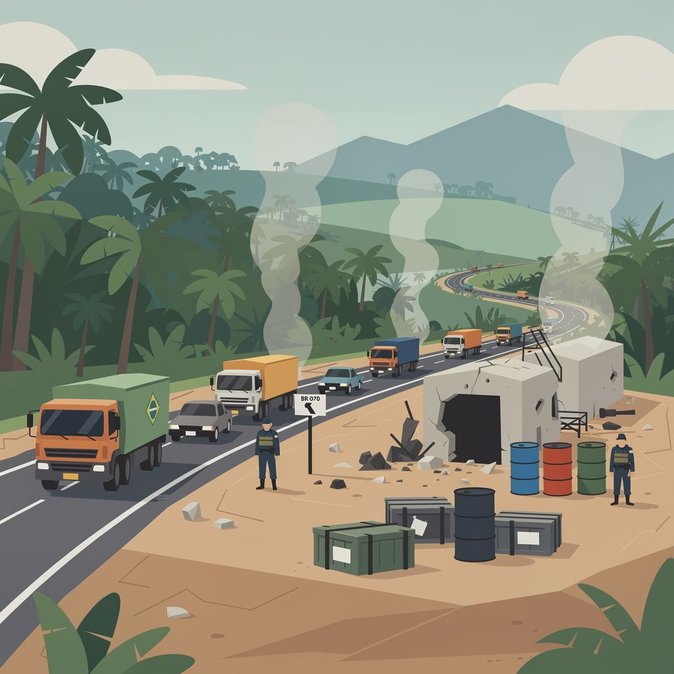
A federal task-force led by Brazil’s Força Nacional uncovered and destroyed 23 underground bunkers used by illegal gold miners inside the Sararé Indigenous Territory, Mato Grosso, in an operation that concluded in the early hours of 15 June 2026. The tunnels—up to five metres long—stored fuel, explosives and machinery valued at R$63 million, authorities said.
For travellers, journalists or logistics personnel who now need to visit Brazil to assess the fallout from this crackdown, VisaHQ can fast-track visa processing and supply real-time entry updates. Its dedicated Brazil page (https://www.visahq.com/brazil/) lets applicants complete forms online, monitor their application status, and secure the correct documentation before arriving, easing passage through heightened checkpoints.
The raid follows U.S. trade representatives’ criticism in March of Brazil’s “weak enforcement” against illicit gold, which they claim distorts markets and violates indigenous rights. The latest sweep involved IBAMA, FUNAI, the Army and the Federal Highway Police, signalling Brasília’s intent to show tangible results ahead of next month’s Amazon Summit. Located fewer than 20 km from the Bolivian border, Sararé has become a corridor for contraband equipment and migrant labour. By neutralising the bunkers, the task-force aims to hinder miners’ ability to resume operations after inspectors withdraw. Similar subterranean structures have been observed in Peru, but this is the first large-scale discovery in Brazil, according to IBAMA. From a mobility standpoint, increased patrols and sporadic roadblocks along BR-070 are expected over the coming weeks, potentially delaying cross-border freight between Cuiabá and Santa Cruz de la Sierra. Logistics companies should alert drivers to carry complete cargo manifests and anticipate longer clearance times at Cáceres customs. The government has not set an end date for the desintrusão (removal) mission. FUNAI is coordinating temporary checkpoints to restrict non-resident entry, meaning adventure-tourism operators targeting the Serra de Ricardo Franco region must obtain fresh permits.
For travellers, journalists or logistics personnel who now need to visit Brazil to assess the fallout from this crackdown, VisaHQ can fast-track visa processing and supply real-time entry updates. Its dedicated Brazil page (https://www.visahq.com/brazil/) lets applicants complete forms online, monitor their application status, and secure the correct documentation before arriving, easing passage through heightened checkpoints.
The raid follows U.S. trade representatives’ criticism in March of Brazil’s “weak enforcement” against illicit gold, which they claim distorts markets and violates indigenous rights. The latest sweep involved IBAMA, FUNAI, the Army and the Federal Highway Police, signalling Brasília’s intent to show tangible results ahead of next month’s Amazon Summit. Located fewer than 20 km from the Bolivian border, Sararé has become a corridor for contraband equipment and migrant labour. By neutralising the bunkers, the task-force aims to hinder miners’ ability to resume operations after inspectors withdraw. Similar subterranean structures have been observed in Peru, but this is the first large-scale discovery in Brazil, according to IBAMA. From a mobility standpoint, increased patrols and sporadic roadblocks along BR-070 are expected over the coming weeks, potentially delaying cross-border freight between Cuiabá and Santa Cruz de la Sierra. Logistics companies should alert drivers to carry complete cargo manifests and anticipate longer clearance times at Cáceres customs. The government has not set an end date for the desintrusão (removal) mission. FUNAI is coordinating temporary checkpoints to restrict non-resident entry, meaning adventure-tourism operators targeting the Serra de Ricardo Franco region must obtain fresh permits.