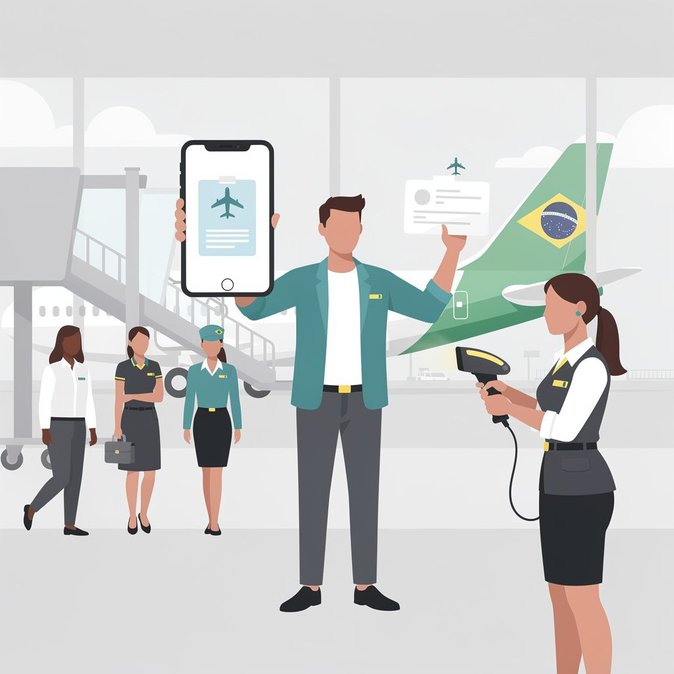
The National Aeronauts Union (SNA) confirmed that, starting 15 June 2026, airline crew members using Brazil’s ‘Passe Livre’ programme are no longer obliged to wear full uniform when travelling on duty-space tickets. The change follows a 16 May memorandum with the National Airline Syndicate (SNEA) that updates security protocols after a series of credential fraud cases last year. ‘Passe Livre’ allows cockpit and cabin crew from any Brazilian carrier to occupy available jump-seats or cabin seats on other domestic airlines free of charge, facilitating repositioning and fatigue management. During a temporary crackdown in 2025, uniform wear became compulsory to help gate agents verify identities. Enhanced digital validation—QR-coded credentials linked to ANAC’s personnel database—has now rendered the dress requirement unnecessary. Airlines have reconfigured their booking portals to incorporate multi-factor authentication and real-time photograph matching. Crew must still carry company ID and licence documents, and the ban on occupying the flight-deck jump-seat on another carrier remains, except under operator-issued waivers. For mobility and duty-of-care managers, the relaxation simplifies last-minute crew logistics, especially on multi-sector rotations where changing into uniforms was impractical. It may also reduce friction at security checkpoints, as staff in civilian attire can proceed through standard screening lanes. The SNA will monitor implementation over the next quarter. Any misuse could prompt a return to stricter rules, the union warned, urging members to “respect the spirit of professional courtesy that sustains the benefit.”