
Speaking to reporters in Dublin on 15 June 2026, Taoiseach Micheál Martin insisted that political attention after last week’s Belfast stabbing should focus on harmonising asylum processes inside the Common Travel Area (CTA) rather than on re-imposing physical border controls between the Republic and Northern Ireland. Martin confirmed that he and UK Prime Minister Keir Starmer discussed the issue by phone on Friday, while Justice Minister Jim O’Callaghan has opened a separate channel with new UK Home Secretary Shabana Mahmood. The stabbing suspect, a Sudanese national who first claimed asylum in Northern Ireland in 2023 after arriving by bus from Dublin, has become a lightning-rod for critics who argue that differences in UK and Irish asylum policy create an exploitable gap. Unionist politicians in Belfast have called for tougher checks on cross-border coaches and ferries, while Dublin is under pressure to demonstrate that its own ports and airports are not the weak point in the CTA chain. Martin countered that “people have got the wrong issue here; the problem is complementarity of processes”, stressing that real-time data-sharing between the UK Home Office, the Police Service of Northern Ireland (PSNI) and An Garda Síochána is the priority. For global-mobility managers the exchange highlights how corporate assignees and cross-border commuters could be caught in tighter, intelligence-led CTA checks if the two governments decide to step up enforcement. HR teams with employees who routinely transit Belfast for tax or housing reasons should review whether staff are carrying appropriate Irish or UK residence documentation at all times. Companies should also expect more frequent spot-checks on rental accommodation and right-to-work compliance in border counties. In practice, neither Dublin nor London is considering passport controls on the island; both remain politically committed to an “invisible” frontier. What is likely, however, is a formal memorandum of understanding on asylum-case information-flows, modelled on the EU’s Eurodac database. If adopted, that could allow officers on either side of the border to verify in seconds whether a third-country national has already lodged a protection claim—and where that claim must be processed under Dublin III successor rules. Businesses should prepare for short-notice policy tweaks. A pilot data-sharing project covering ferry routes between Holyhead and Dublin Port is already on the Justice Department’s agenda. Travel-management providers would need to capture additional passenger passport data at booking stage, while relocation firms should brief clients on the heightened risk of detention for undocumented accompanying family members.
Source: Meath Chronicle
How VisaHQ can help
VisaHQ simplifies the visa application process for individuals and businesses. Check current travel requirements, prepare the required documents and manage your application online through the VisaHQ Ireland portal.More From Ireland
View all
EU Migration & Asylum Pact takes effect – Irish employers urged to audit mobility programmes
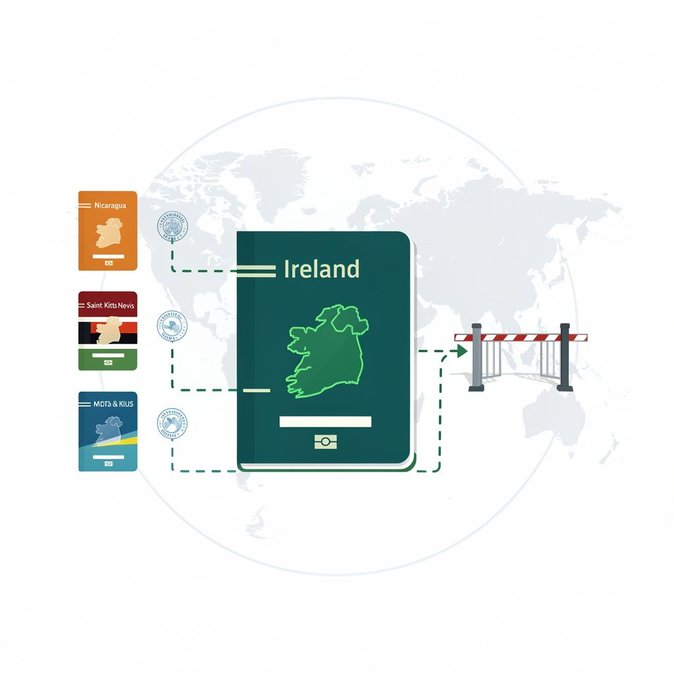
Ireland imposes visa requirement on Nicaragua, Saint Kitts & Nevis and Saint Lucia nationals from 15 June