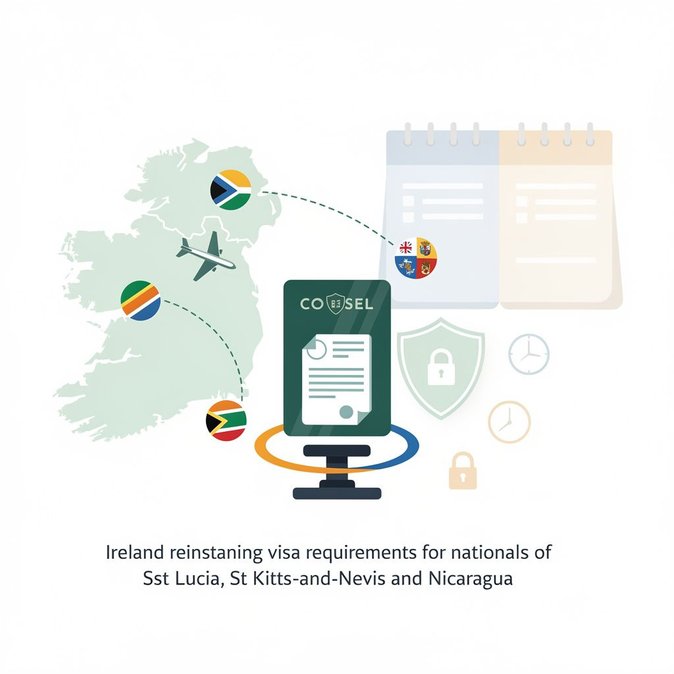
In a late-evening announcement on 15 June 2026, Ireland’s Department of Justice, Home Affairs and Migration confirmed that nationals of Saint Lucia, St Kitts-and-Nevis and Nicaragua will no longer enjoy visa-free entry to the State. The decision—signed by Minister for Migration Colm Brophy—took effect at midnight on 15 June and applies to ordinary, diplomatic and service passports as well as air-side transit. Officials say the move is designed to keep Ireland’s external border standards aligned with partners in the U.K. Common Travel Area and the wider Schengen zone. London removed Nicaragua and Saint Lucia from its Electronic Travel Authorisation list earlier this year, citing rising asylum claims and security concerns linked to Citizenship-by-Investment (CBI) programmes. Brussels has likewise tightened its visa-suspension mechanism, explicitly allowing restrictions where CBI schemes pose security or organised-crime risks. Under temporary transition rules, travellers from the three Caribbean and Central American states who booked itineraries before 15 June and arrive in Ireland on or before 14 July 2026 may still travel without a visa—provided they can show proof of booking, a valid passport and onward/return tickets. Anyone booking after 15 June must obtain a Type C short-stay or transit visa in advance; Irish Residence Permit (IRP) holders remain exempt. For Irish businesses the change means extra lead-time for any staff, customers or contractors holding the affected passports. Processing is handled by the Irish Embassy in Ottawa, with published turnaround times of 8-10 weeks. Employers planning Caribbean roadshows, sporting fixtures, or seasonal farm-labour programmes will need to budget for the €100 single-entry fee and the possibility of refusals—now un-appealable since Ireland abolished administrative appeals for short-stay visas on 1 June. In the Caribbean, Saint Lucia’s Prime Minister Philip J. Pierre has already briefed citizens on the new requirements. By contrast, St Kitts-Nevis has yet to issue detailed guidance—prompting criticism from business groups who fear the loss of previously visa-free access to one of Europe’s key English-speaking markets. The episode underlines how quickly mobility privileges can shift for CBI jurisdictions and the need for agile corporate travel policies.
Source: Times Caribbean Online