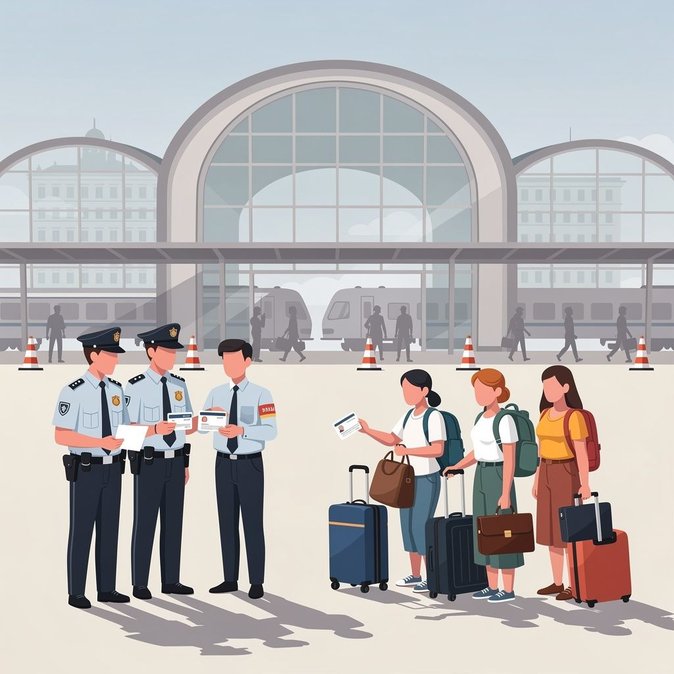
Vienna’s city police, together with officers from the Federal Office for Immigration and Asylum (BFA) and municipal enforcement teams, carried out an unannounced control operation around Mariahilfer Straße and Westbahnhof on 15 June. Details were released on 16 June. Over the three-hour sweep officers verified the identities of 58 people, issued seven administrative citations and arrested six individuals on immigration-law grounds. Officials said the action is part of a summer campaign targeting trafficking networks and petty crime hotspots at major transport nodes.
For individuals and employers navigating Austria’s complex entry rules, VisaHQ can streamline applications for visas, residence permits and travel documents through its dedicated Austria portal (https://www.visahq.com/austria/). The platform offers up-to-date guidance, document checklists and concierge support, making it easier to avoid the kinds of lapses that lead to on-the-spot fines or detentions.
Since Austria is still operating internal Schengen checks at four land borders, the interior ministry argues that intensified in-country policing is needed to prevent “secondary movements” from neighbouring states. The city of Vienna, which joined the operation, added fines for violations of local clean-street and street-art statutes. For employers the practical impact is two-fold. First, foreign assignees—even EU nationals—should carry passports or national ID when moving around the capital’s transport hubs; police are increasingly invoking provisions of the Sicherheits-polizeigesetz to demand on-the-spot identification. Second, HR teams should review document-carrying policies for posted workers and business travellers to avoid delays or fines if staff are stopped during commutes between client sites. Law firms note that arrests under the Fremdenpolizeigesetz often relate to residence cards that have lapsed after job changes or lengthy periods outside Austria. The BFA says it will speed up electronic checks via the new E-Residence database rolled out in April, meaning that overstays may be detected more quickly. Companies are therefore advised to ensure timely renewals of Red-White-Red cards and to keep travel history records in case of questions. Although the sweep was localised, authorities hinted that similar operations will be staged at Vienna-Meidling station and the airport rail terminal in the coming weeks as tourist arrivals peak. Mobility managers should brief travellers accordingly, especially those entering on short-stay visa-free regimes who might not routinely carry all supporting documents once inside Austria.
For individuals and employers navigating Austria’s complex entry rules, VisaHQ can streamline applications for visas, residence permits and travel documents through its dedicated Austria portal (https://www.visahq.com/austria/). The platform offers up-to-date guidance, document checklists and concierge support, making it easier to avoid the kinds of lapses that lead to on-the-spot fines or detentions.
Since Austria is still operating internal Schengen checks at four land borders, the interior ministry argues that intensified in-country policing is needed to prevent “secondary movements” from neighbouring states. The city of Vienna, which joined the operation, added fines for violations of local clean-street and street-art statutes. For employers the practical impact is two-fold. First, foreign assignees—even EU nationals—should carry passports or national ID when moving around the capital’s transport hubs; police are increasingly invoking provisions of the Sicherheits-polizeigesetz to demand on-the-spot identification. Second, HR teams should review document-carrying policies for posted workers and business travellers to avoid delays or fines if staff are stopped during commutes between client sites. Law firms note that arrests under the Fremdenpolizeigesetz often relate to residence cards that have lapsed after job changes or lengthy periods outside Austria. The BFA says it will speed up electronic checks via the new E-Residence database rolled out in April, meaning that overstays may be detected more quickly. Companies are therefore advised to ensure timely renewals of Red-White-Red cards and to keep travel history records in case of questions. Although the sweep was localised, authorities hinted that similar operations will be staged at Vienna-Meidling station and the airport rail terminal in the coming weeks as tourist arrivals peak. Mobility managers should brief travellers accordingly, especially those entering on short-stay visa-free regimes who might not routinely carry all supporting documents once inside Austria.