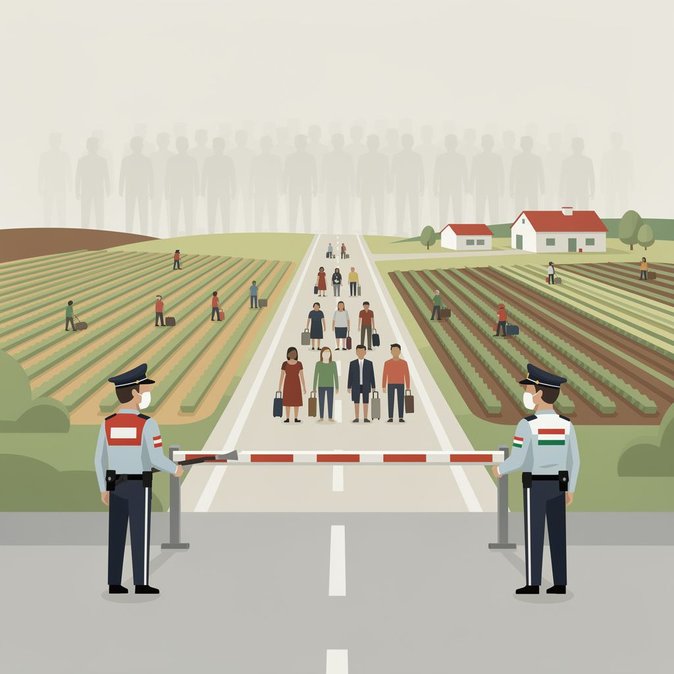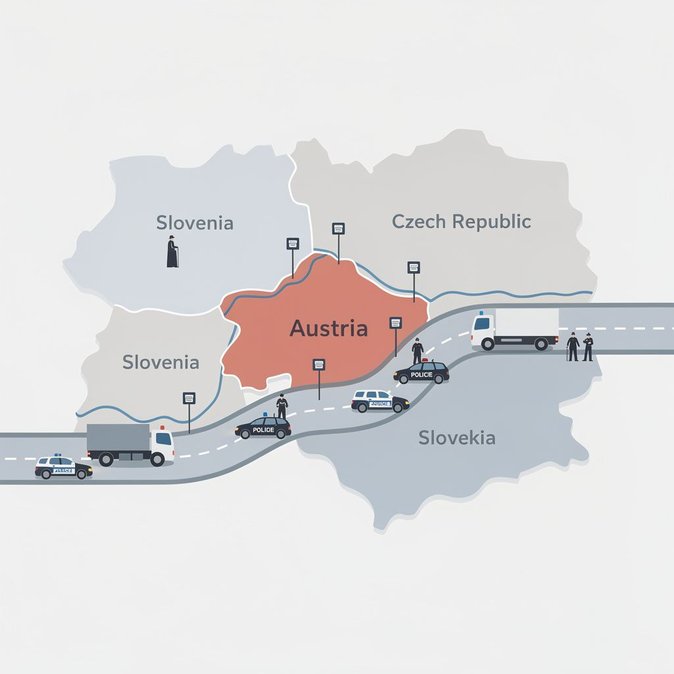
Austria will keep temporary controls on its land borders with Slovenia, Hungary, the Czech Republic and Slovakia until mid-September, Interior Minister Gerhard Karner announced on 15 June. The measure, first introduced at the height of the 2015 refugee crisis and renewed every six months since, had been due to expire yesterday. Vienna argues that the step remains necessary to curb irregular migration and people-smuggling, despite repeated calls from the European Commission for Schengen members to return to a control-free regime.
According to the Ministry of the Interior, the new extension will replace fixed checkpoints with a more “mobile and flexible” concept. Mixed patrols of federal police and army personnel will fan out up to 30 kilometres inside Austrian territory, supported by mobile biometric identification units and automatic number-plate recognition vans. Karner stressed that the objective was “to target smugglers, not to burden bona-fide travellers,” promising that freight flows and daily commuter traffic would face minimal disruption.
The decision comes just days after the EU’s new Pact on Migration and Asylum entered into application, which Brussels believes offers alternatives to internal controls such as cross-border police cooperation and joint risk analysis. Austria counters that the external Schengen border in the Western Balkans remains porous and that secondary movements toward central Europe are still significant.
For travellers who now need to pay closer attention to their documentation when crossing Austria’s borders, VisaHQ can simplify the process. The company’s Austria page (https://www.visahq.com/austria/) provides real-time updates on visa and passport requirements, assists with residence permit applications, and offers practical tips to ensure compliance during the mobile spot checks announced by the authorities. This support helps both businesses and individual visitors avoid unnecessary delays and travel disruptions.
Government figures show 19,800 asylum applications in 2025—down from the 112,000 peak in 2022, but still more than double the pre-pandemic average. Business associations reacted with mixed feelings. The Austrian Chamber of Commerce (WKÖ) welcomed the shift to mobile controls, noting that long truck queues at the Spielfeld and Nickelsdorf crossings had cost exporters an estimated €17 million in delivery penalties during last winter alone. Tourism bodies, however, fear that repeated extensions send the wrong signal ahead of the critical summer season, especially to self-drive visitors from neighbouring EU states.
Practically, companies moving staff or goods through the affected frontiers should expect occasional on-the-road spot checks, particularly at secondary crossings and motorway service areas. Employers are advised to ensure that non-EU assignees carry passports and residence documents even when travelling wholly inside the Schengen Area, and to build minor buffer times into cross-border itineraries until at least 15 September 2026.
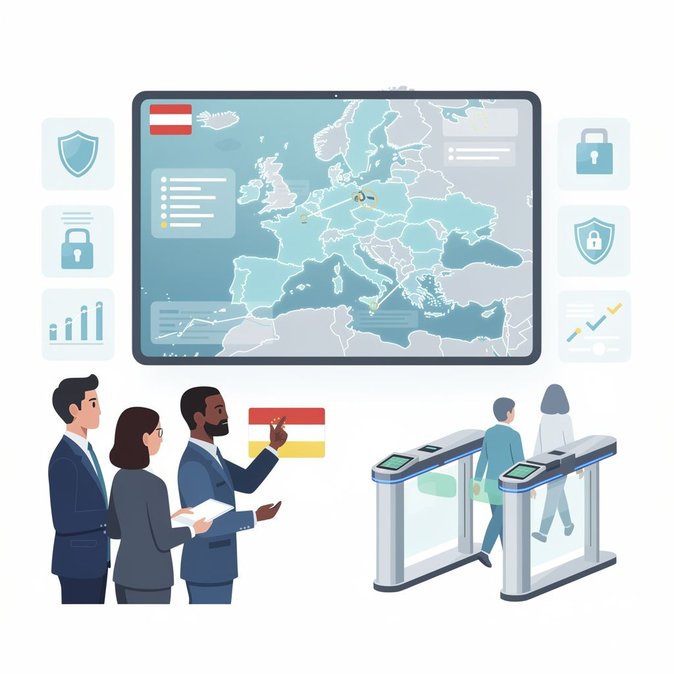
According to the Ministry of the Interior, the new extension will replace fixed checkpoints with a more “mobile and flexible” concept. Mixed patrols of federal police and army personnel will fan out up to 30 kilometres inside Austrian territory, supported by mobile biometric identification units and automatic number-plate recognition vans. Karner stressed that the objective was “to target smugglers, not to burden bona-fide travellers,” promising that freight flows and daily commuter traffic would face minimal disruption.
The decision comes just days after the EU’s new Pact on Migration and Asylum entered into application, which Brussels believes offers alternatives to internal controls such as cross-border police cooperation and joint risk analysis. Austria counters that the external Schengen border in the Western Balkans remains porous and that secondary movements toward central Europe are still significant.
For travellers who now need to pay closer attention to their documentation when crossing Austria’s borders, VisaHQ can simplify the process. The company’s Austria page (https://www.visahq.com/austria/) provides real-time updates on visa and passport requirements, assists with residence permit applications, and offers practical tips to ensure compliance during the mobile spot checks announced by the authorities. This support helps both businesses and individual visitors avoid unnecessary delays and travel disruptions.
Government figures show 19,800 asylum applications in 2025—down from the 112,000 peak in 2022, but still more than double the pre-pandemic average. Business associations reacted with mixed feelings. The Austrian Chamber of Commerce (WKÖ) welcomed the shift to mobile controls, noting that long truck queues at the Spielfeld and Nickelsdorf crossings had cost exporters an estimated €17 million in delivery penalties during last winter alone. Tourism bodies, however, fear that repeated extensions send the wrong signal ahead of the critical summer season, especially to self-drive visitors from neighbouring EU states.
Practically, companies moving staff or goods through the affected frontiers should expect occasional on-the-road spot checks, particularly at secondary crossings and motorway service areas. Employers are advised to ensure that non-EU assignees carry passports and residence documents even when travelling wholly inside the Schengen Area, and to build minor buffer times into cross-border itineraries until at least 15 September 2026.