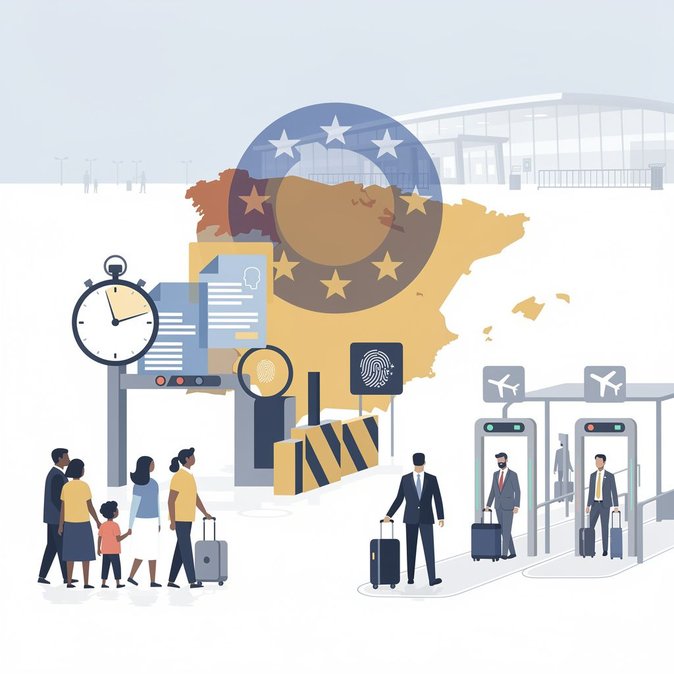
Spain woke up on 17 June to a completely new European migration landscape. At one minute past midnight the long-debated EU Pact on Migration and Asylum formally entered into force, triggering a cascade of legal changes that Spain must transpose into domestic practice within the next six months. The pact streamlines asylum screening in external border zones, links negative decisions to an automatic return order and obliges every Member State—including Spain—to accept a share of either relocations or financial contributions when frontline countries are overwhelmed. In Spain the Interior Ministry confirmed that *fast-track* border procedures will now be mandatory in international transit zones at Madrid-Barajas, Barcelona-El Prat, Málaga-Costa del Sol and at the Ceuta and Melilla land frontiers. Applicants judged to have a low probability of success must receive a first-instance decision within 12 weeks, leaving lawyers and NGOs scrambling to shore up on-site legal capacity. The government will also have to scale up detention places for returns and create a new ‘solidarity reserve’ of 1,800 places for people relocated from Greece and Italy this year. Corporate mobility managers should monitor processing times closely: staff transferred on highly-qualified EU Blue Cards will see little change, but family-reunification and humanitarian applicants transiting Spain’s external borders can now be channelled into the accelerated procedure, increasing the risk of an unexpected refusal. Airlines operating long-haul flights into Madrid and Barcelona must also incorporate the pact’s advance passenger-data rules, which require carriers to transmit additional biometric fields to Frontex before wheels-up. Failure to comply will incur fines of up to €40,000 per incident. Spanish NGOs have criticised the pact for shifting the balance towards control rather than protection; business groups, meanwhile, welcome the promise of more uniform rules across the EU. Either way, HR departments have a tight window to update global-mobility policies, traveller checklists and crisis-response protocols before the first accelerated border decisions are issued this summer.
Source: elDiario.es