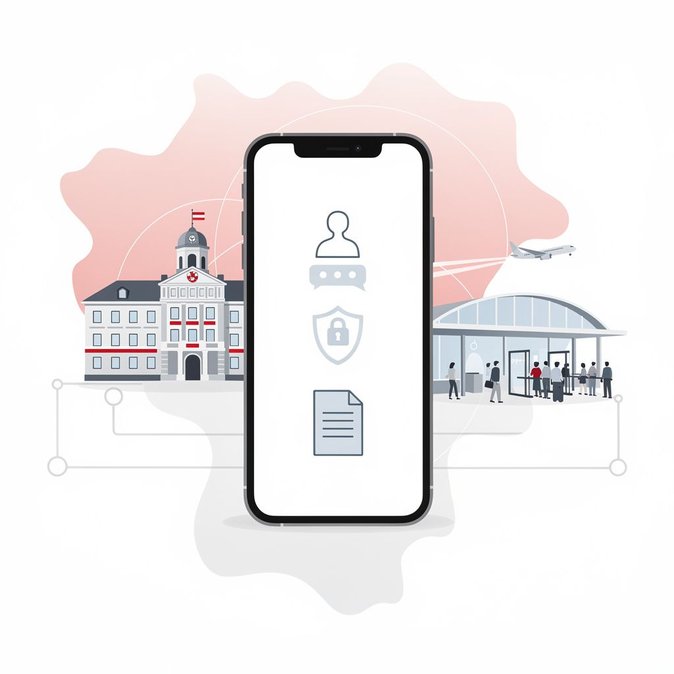
Austria’s digital-government ambitions took a visible leap forward on 18 June 2026 when State Secretary for Digitalisation Alexander Pröll unveiled a major relaunch of the ID Austria mobile application. From this summer every holder of an ID Austria e-identity will gain access to “ida”, a large-language-model chatbot able to answer questions about residence registration, driving-licence renewals, visa appointments and more in plain German. The assistant is hosted entirely on infrastructure run by the Federal Computing Centre to avoid any transfer of personal data abroad. The update also introduces a long-requested mobile “Vertretungsfunktion” (proxy login). For the first time, parents, lawyers and corporate mobility managers can log in on behalf of someone else using an authorisation stored in the national eID system. That feature is expected to eliminate thousands of in-person visits to district authorities each year and should be particularly useful for expatriates who need relatives or relocation agents to act for them while they are still abroad. Equally significant for travellers is the one-tap link to the eAusweise wallet on the app’s start screen. Although Austrian electronic documents are not yet accepted at foreign borders, Vienna International Airport already lets passengers use a digital driving licence or residency permit at domestic security checkpoints, and the Ministry of the Interior is lobbying Brussels for eventual cross-border recognition. The redesign therefore lays the groundwork for smoother passenger flows once the EU’s forthcoming digital-identity regulation is in force. Pröll emphasised that accessibility was a guiding principle: the development team consulted blind, deaf and mobility-impaired users and committed to a fully barrier-free version in 2027. A nationwide “ID Austria Service Tour” between 1 July and 31 August will let residents activate the new functions at pop-up stands in all nine provinces. Companies that move staff to Austria are being advised to schedule ID-Austria registrations well before the busy autumn start-up season. For corporate mobility managers, the message is clear: Austria is betting on digital identity as the backbone of future immigration procedures. Familiarising transferees with the app now should pay dividends when the EU Entry/Exit System and the bloc’s planned European Digital Identity Wallet start to interact with national solutions in 2027.
Source: Bundeskanzleramt Österreich