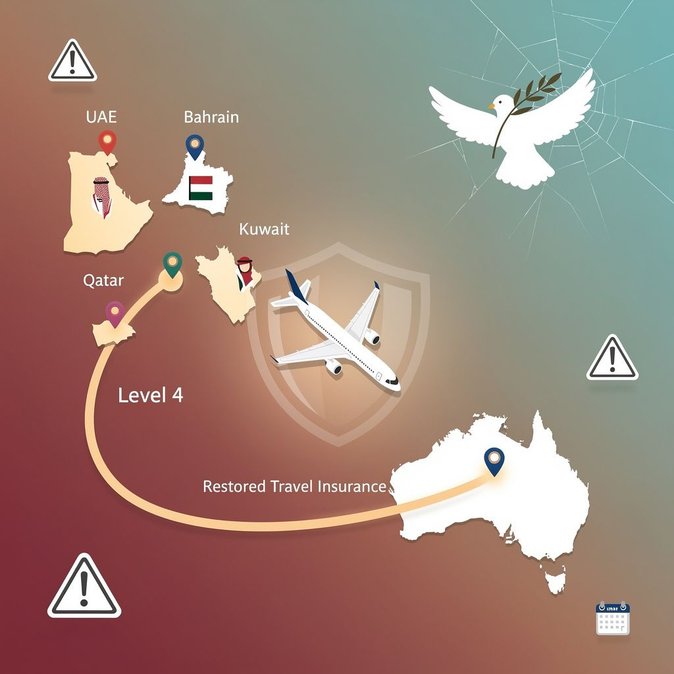
Australia’s Department of Foreign Affairs and Trade (DFAT) has lowered its Smartraveller warning for the United Arab Emirates, Bahrain, Kuwait, Qatar and Israel from ‘Level 4 – Do Not Travel’ to ‘Level 3 – Reconsider Your Need to Travel’. The change, logged on 18 June and reported internationally on 19 June 2026, follows a US-brokered extension of the US-Iran ceasefire.
1. Immediate effects on travellers
The downgrade means most Australian travel-insurance policies once again cover trips that include a lay-over in Dubai, Doha or Abu Dhabi. Qantas’ Perth–London nonstop via Singapore remains unchanged, but Emirates, Etihad and Qatar Airways continue to operate multiple daily flights to Australia, now without the insurance-voiding stigma.
2. Corporate-mobility considerations
Companies with fly-in technical teams can resume routing talent through Gulf hubs without triggering corporate-risk exceptions. Policy manuals referencing Smartraveller levels should be updated promptly.
Before locking in flights, Australian passport holders and other travellers should also ensure their entry documentation is in order. VisaHQ, an online visa-processing service, can quickly confirm whether you need a transit or full visa for the United Arab Emirates and handle the application end-to-end, with live tracking and customer support: https://www.visahq.com/united-arab-emirates/ Integrating this tool into corporate travel workflows can further reduce administrative overhead as regional alert levels continue to shift.
3. The 60-day caveat
DFAT tied the downgrade explicitly to the ceasefire’s 60-day review cycle, warning that any resumption of drone or missile attacks could reinstate Level 4 advice without notice. Mobility managers are urged to build contingency routings via Singapore or Bangkok.
4. Wider business impact
Gulf carriers rely heavily on Australian feed traffic; the softer advisory is expected to boost forward bookings for Expo-related travel to Dubai and leisure flows to Europe via the Gulf this northern-summer peak.
5. Bottom line
While not a visa change, the advisory shift materially lowers cost and risk for Australian corporates moving staff through the UAE. Continuous monitoring remains essential.
1. Immediate effects on travellers
The downgrade means most Australian travel-insurance policies once again cover trips that include a lay-over in Dubai, Doha or Abu Dhabi. Qantas’ Perth–London nonstop via Singapore remains unchanged, but Emirates, Etihad and Qatar Airways continue to operate multiple daily flights to Australia, now without the insurance-voiding stigma.
2. Corporate-mobility considerations
Companies with fly-in technical teams can resume routing talent through Gulf hubs without triggering corporate-risk exceptions. Policy manuals referencing Smartraveller levels should be updated promptly.
Before locking in flights, Australian passport holders and other travellers should also ensure their entry documentation is in order. VisaHQ, an online visa-processing service, can quickly confirm whether you need a transit or full visa for the United Arab Emirates and handle the application end-to-end, with live tracking and customer support: https://www.visahq.com/united-arab-emirates/ Integrating this tool into corporate travel workflows can further reduce administrative overhead as regional alert levels continue to shift.
3. The 60-day caveat
DFAT tied the downgrade explicitly to the ceasefire’s 60-day review cycle, warning that any resumption of drone or missile attacks could reinstate Level 4 advice without notice. Mobility managers are urged to build contingency routings via Singapore or Bangkok.
4. Wider business impact
Gulf carriers rely heavily on Australian feed traffic; the softer advisory is expected to boost forward bookings for Expo-related travel to Dubai and leisure flows to Europe via the Gulf this northern-summer peak.
5. Bottom line
While not a visa change, the advisory shift materially lowers cost and risk for Australian corporates moving staff through the UAE. Continuous monitoring remains essential.