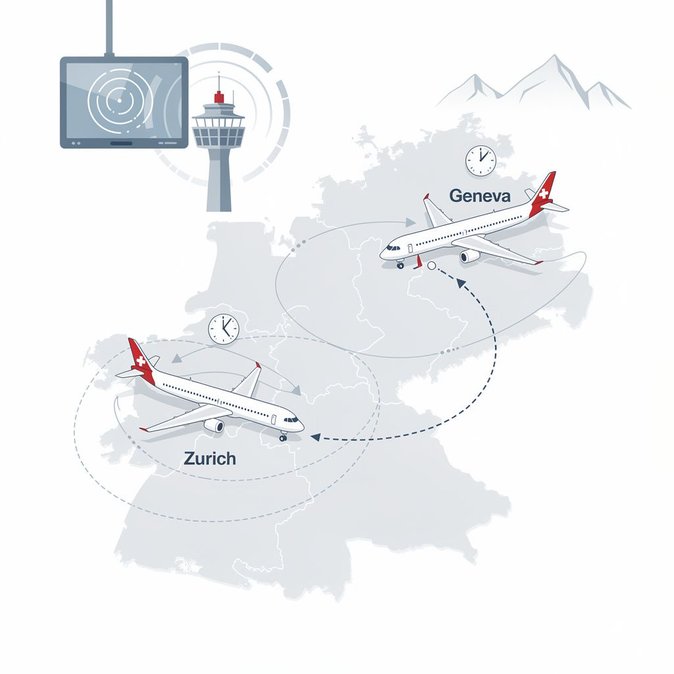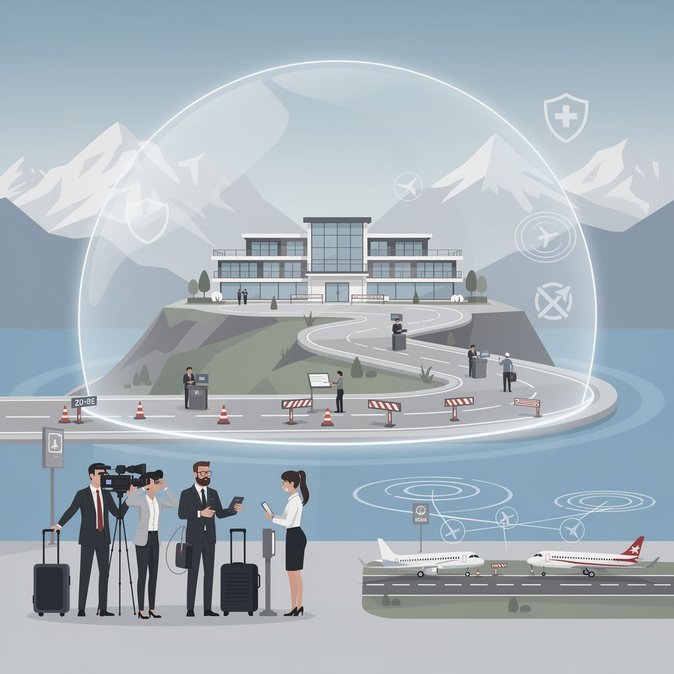
A hastily-imposed no-fly zone over central Switzerland for Sunday’s opening of the US-Iran peace talks on Mount Bürgenstock produced an unexpected side effect 60 kilometres away: a cascading radar fault that paralysed early-morning departures at Zurich Airport. According to air-navigation provider Skyguide, the security zone had to be integrated into the nationwide air-traffic-management system overnight after the venue was confirmed only on Saturday. When controllers activated the virtual exclusion ring shortly after 05:00 on 21 June, a software conflict blanked parts of the radar display at both the Dübendorf area control centre and Zurich’s tower, forcing an immediate shutdown of east-of-Bern airspace. No take-offs were permitted for nearly two hours; 43 departures were cancelled and dozens more delayed, while arriving aircraft were funnelled through a single corridor to keep inbound traffic moving. By 07:45 engineers had isolated the coding error and began a phased reopening. Normal operations were restored by mid-morning, but Skyguide is keeping a 10 % capacity buffer on overflights until 08:00 on Monday, 22 June, in case further adjustments are needed. Zurich Airport, a critical hub for multinational headquarters in the Greater Zurich Area, estimates the incident inconvenienced close to 7,000 passengers—including Monday-morning business travellers heading for Europe’s financial centres. The glitch underscores how fast-moving diplomatic events can ripple through civilian mobility infrastructure. Switzerland regularly establishes temporary restricted areas for high-level summits—Davos during the World Economic Forum being the best-known example—but those zones are usually planned weeks in advance. In this case the compressed lead-time left little margin for end-to-end testing of the software patch that defines the virtual perimeter and its altitude layers. Corporate mobility managers were quick to react. Several relocation firms advised assignees arriving from Asia to re-route via Geneva or Munich, while companies with same-day connections rescheduled meetings or switched to virtual formats. Travel-risk advisers say the episode is a reminder that even Switzerland’s famously reliable aviation system is not immune to disruption when geopolitics intrude. They recommend building longer connection buffers during major international events and registering itineraries with providers that offer real-time disruption alerts. In the short term, Skyguide is launching a post-incident review with the Federal Office of Civil Aviation. Longer-term, the agency plans to create a dedicated ‘summit sandbox’ to test restricted-zone overlays without touching the live system—a move welcomed by the Swiss Business Aviation Association, which said predictable access to Zurich is essential for maintaining the country’s attractiveness as a headquarters location.
Source: SWI swissinfo.ch