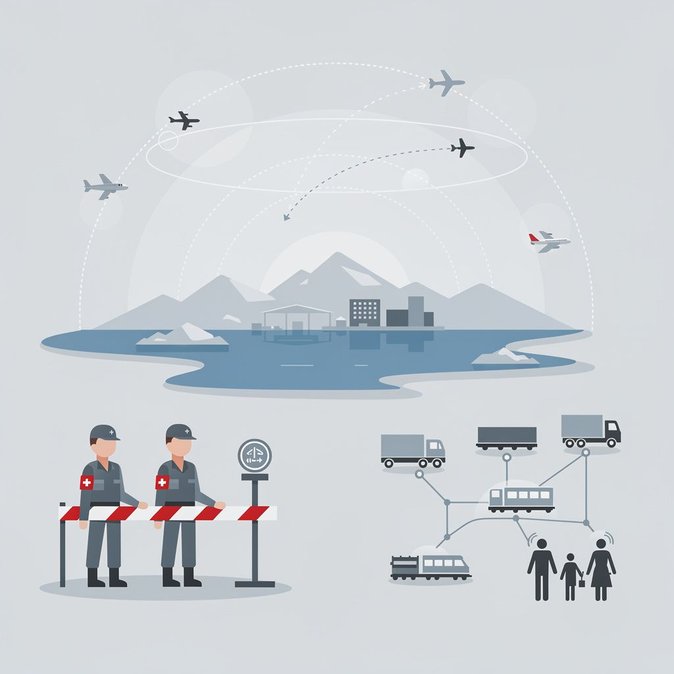
Switzerland’s largest security deployment of the year wound down on 23 June 2026 after the two-day Lake Lucerne Summit concluded without incident. The Federal Council had authorised up to 2,000 soldiers to support cantonal police and to enforce a wide-radius restricted zone around the Bürgenstock resort, where heads of state from eight Alpine and Adriatic countries discussed climate adaptation and labour-mobility cooperation. The Swiss Air Force monitored a 46-kilometre no-fly ring; five civilian aircraft breached the zone and were escorted out.
Business travellers headed to events like this often find last-minute entry requirements changing in real time. VisaHQ’s Switzerland portal (https://www.visahq.com/switzerland/) can verify visa exemptions, arrange expedited documentation, and keep travellers abreast of temporary border controls so their itineraries remain intact—even when security situations tighten without much warning.
Meanwhile, customs officers ran ad-hoc checks on cross-border traffic using the A2 and A13 corridors, causing brief delays for freight forwarders rerouting high-value cargo between Germany and Italy. With the summit finished, normal Schengen border procedures resumed at 06:00 on 24 June, and NOTAMs restricting visual-flight operations have been cancelled. Charter-flight providers and corporate aviation managers can once again file direct routings over central Switzerland without slot constraints. Although the disruption lasted only five days, it offered a live rehearsal for larger events such as the 2027 Winter Youth Olympics in Graubünden, where similar mixed civil-military security concepts are planned. The defence ministry reported "marginal additional cost" thanks to the use of standing readiness budgets, but aviation groups are calling for earlier stakeholder briefings to minimise last-minute detours. Companies moving VIPs or time-critical goods through Zurich or Milan during the summit period should review contingency clauses in service-level agreements. The episode underlines how high-profile political gatherings—even domestic ones—can ripple across supply chains and executive-travel schedules.
Business travellers headed to events like this often find last-minute entry requirements changing in real time. VisaHQ’s Switzerland portal (https://www.visahq.com/switzerland/) can verify visa exemptions, arrange expedited documentation, and keep travellers abreast of temporary border controls so their itineraries remain intact—even when security situations tighten without much warning.
Meanwhile, customs officers ran ad-hoc checks on cross-border traffic using the A2 and A13 corridors, causing brief delays for freight forwarders rerouting high-value cargo between Germany and Italy. With the summit finished, normal Schengen border procedures resumed at 06:00 on 24 June, and NOTAMs restricting visual-flight operations have been cancelled. Charter-flight providers and corporate aviation managers can once again file direct routings over central Switzerland without slot constraints. Although the disruption lasted only five days, it offered a live rehearsal for larger events such as the 2027 Winter Youth Olympics in Graubünden, where similar mixed civil-military security concepts are planned. The defence ministry reported "marginal additional cost" thanks to the use of standing readiness budgets, but aviation groups are calling for earlier stakeholder briefings to minimise last-minute detours. Companies moving VIPs or time-critical goods through Zurich or Milan during the summit period should review contingency clauses in service-level agreements. The episode underlines how high-profile political gatherings—even domestic ones—can ripple across supply chains and executive-travel schedules.