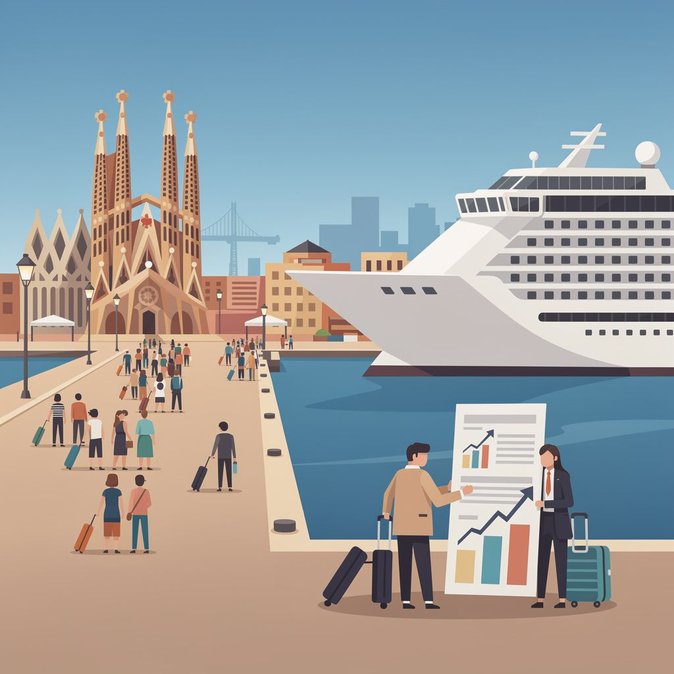
The Barcelona City Council has fired a new warning shot at the cruise industry. In an article published by specialist outlet Hosteltur on 23 June 2026, the municipality confirmed that it will take advantage of a forthcoming change to the Catalan tourist-tax law to raise the municipal surcharge on cruise passengers who remain in the city for fewer than 12 hours from the current €6 to a record €24. Added to the €6 regional levy, short-stay cruise guests will soon pay €30 each time they disembark in the Catalan capital. Although the exact implementation date still depends on the regional budget process and subsequent modification of local ordinances, Mayor Jaume Collboni left no doubt about his ultimate objective: to “reduce to zero” transient cruise calls that, in his words, contribute disproportionately to crowding while generating limited economic return. To reinforce that goal, the city has also floated a long-term plan to cut the number of cruise terminals, prioritising home-port operations that channel more overnight spending into hotels and other local businesses. The move has provoked an immediate backlash from Cruise Lines International Association (CLIA), which cites a new study showing that cruise visitors account for just 2.5 % of Barcelona’s daily tourist load. CLIA argues that the measure is punitive and could push lines to shift itineraries to rival western-Mediterranean hubs, eroding the city’s maritime cluster and thousands of related jobs. For global-mobility and corporate-travel managers, the proposed €30 levy adds another cost layer to meetings and incentives that use Barcelona as turnaround port or day-trip call. Cruise-sector employers will need to update travel budgets and clearly communicate the higher incidental charge to passengers and crew. Destination-management companies should be ready to propose alternative Spanish ports—Valencia, Málaga or Palma—if clients balk at the new economics. More broadly, the crackdown underscores the political momentum behind “de-massification” strategies in Spain’s marquee destinations. After Airbnb licences in Barcelona were capped earlier this year and shared-bike schemes face new restrictions, cruise tourism is the latest segment under pressure to demonstrate a higher net contribution to the local economy while mitigating environmental and social externalities.
Source: Hosteltur