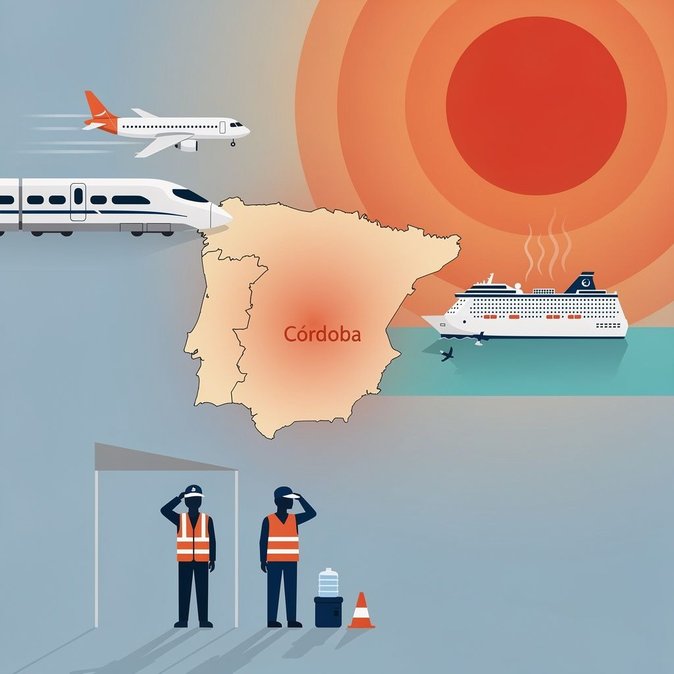
Spain’s State Meteorological Agency (AEMET) issued some of its strongest warnings of the year on 23 June 2026, placing almost the entire country under heat alerts—ten autonomous communities at orange level and three (Andalucía, Cantabria and País Vasco) at the maximum red. Temperatures were forecast to top 44 °C in Córdoba, while nighttime ‘tropical minima’ above 25 °C threatened to strain power grids and public health services. Transport operators immediately rolled out contingency measures. Renfe activated heat protocols that allow slower train speeds on sections where rail temperatures exceed safe thresholds, potentially lengthening AVE journey times between Madrid and Sevilla.
Travellers who do need to update visas or residence permits as plans shift can streamline the paperwork online with VisaHQ; the platform’s Spain portal (https://www.visahq.com/spain/) provides up-to-date entry requirements, digital application tools and live support—meaning mobility teams can refocus on heat-related contingencies while VisaHQ handles the documentation.
Aena reminded airlines of extended tarmac-time limits for ground crews, while Barcelona’s port authority advised cruise lines to adjust excursion schedules to cooler hours. For global mobility managers, the main concern is duty-of-care. Companies with assignees in southern Spain were urged to review local cooling-centre locations and reinforce hydration guidance. Travellers transiting through hub airports such as Adolfo Suárez Madrid-Barajas should allow extra connection buffers in case of runway-temperature holds. The heatwave also dovetails with Spain’s new occupational-safety rules, which since 2025 require employers to suspend outdoor work when the Health Ministry declares red heat risk. Fines can reach €45,000 for non-compliance, so construction and logistics providers supporting relocation projects must monitor AEMET bulletins closely. Climatologists warn that successive early-summer heat events are becoming the new normal on the Iberian Peninsula, accelerating the need for heat-resilient travel planning—ranging from shaded immigration-queue zones at airports to revised bus-tour itineraries—well before the peak tourist influx in July and August.
Travellers who do need to update visas or residence permits as plans shift can streamline the paperwork online with VisaHQ; the platform’s Spain portal (https://www.visahq.com/spain/) provides up-to-date entry requirements, digital application tools and live support—meaning mobility teams can refocus on heat-related contingencies while VisaHQ handles the documentation.
Aena reminded airlines of extended tarmac-time limits for ground crews, while Barcelona’s port authority advised cruise lines to adjust excursion schedules to cooler hours. For global mobility managers, the main concern is duty-of-care. Companies with assignees in southern Spain were urged to review local cooling-centre locations and reinforce hydration guidance. Travellers transiting through hub airports such as Adolfo Suárez Madrid-Barajas should allow extra connection buffers in case of runway-temperature holds. The heatwave also dovetails with Spain’s new occupational-safety rules, which since 2025 require employers to suspend outdoor work when the Health Ministry declares red heat risk. Fines can reach €45,000 for non-compliance, so construction and logistics providers supporting relocation projects must monitor AEMET bulletins closely. Climatologists warn that successive early-summer heat events are becoming the new normal on the Iberian Peninsula, accelerating the need for heat-resilient travel planning—ranging from shaded immigration-queue zones at airports to revised bus-tour itineraries—well before the peak tourist influx in July and August.