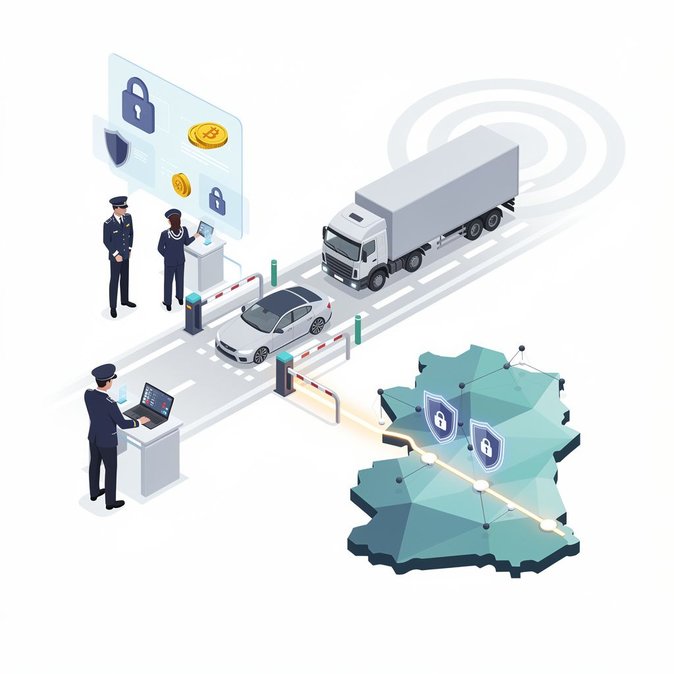
Border security along Poland’s eastern flank is no longer defined solely by fences and passport booths. On 23 June 2026 the Warmińsko-Mazurski Border Guard District reported the completion of an intensive five-day course titled “Cyber-crime as a real trans-national threat,” delivered jointly with Lithuania under the Interreg VI-A “Border Safeguard” project. The programme, held earlier in Chorzów and summarised this week, brought together 24 Polish and 12 Lithuanian officers for hands-on exercises in tracing cryptocurrency flows, open-source intelligence (OSINT) and mapping hybrid attack vectors that can be used to destabilise border operations. The initiative responds to a marked increase in digitally facilitated offences along the Suwałki Gap and the broader Polish-Lithuanian frontier. Polish commanders told participants that since the launch of the EU Entry/Exit System (EES) in 2025, smugglers have shifted from forged documents to data manipulation—spoofing biometric enrolments or hacking queue-management platforms to create diversions at checkpoints. Officers practised using blockchain-analysis software to follow ransom payments and learned how to preserve digital evidence in cross-border prosecutions. Beyond pure technology, the course drilled joint crisis-communication protocols. A simulated disinformation wave—fake social-media posts claiming that the Budzisko–Kalvarija crossing was closed—tested how quickly the two services could issue unified travel advisories and redirect commercial traffic. Participants highlighted that seamless information-sharing is essential to protect the Via Baltica corridor, which carries a growing volume of just-in-time freight for Nordic manufacturers. Project managers confirmed that the Interreg budget will finance three further modules this autumn, covering tactical medical response, drone-borne surveillance and coordinated crowd control. In total, 190 Polish and Lithuanian officers will be up-skilled by mid-2027. For multinational companies moving staff or goods through north-eastern Poland, the programme should translate into faster incident resolution and fewer unplanned closures—provided that cyber security keeps pace with physical defences. Corporate mobility teams are advised to add cyber-incident clauses to travel-risk assessments and to monitor Polish and Lithuanian border-guard social channels for verified status updates before routing sensitive shipments.