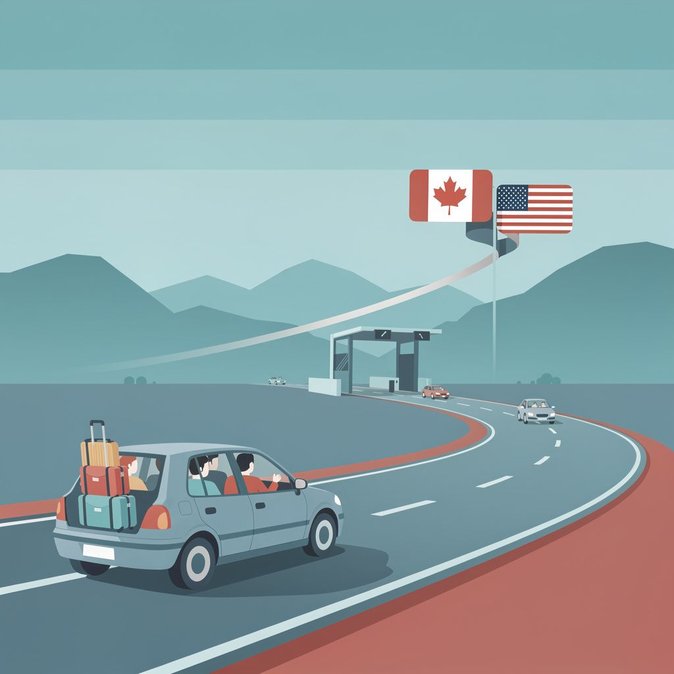
New April border-crossing data released by Statistics Canada and highlighted by Pax News on June 23 show Canadian resident trips to the United States rising 1.8 % year-over-year—the first positive reading in 15 months. The uptick, driven by an 8.1 % jump in same-day vehicle traffic, hints at a stabilising cross-border travel market following a prolonged slump blamed on exchange-rate weakness and U.S. policy uncertainty. Roughly 1.5 million road journeys were recorded in April, representing nearly two-thirds of all Canadian visits south of the border.
For Canadians eager to take advantage of this rebound but unsure about documentation requirements—especially if their itinerary includes onward travel beyond the United States—VisaHQ can help streamline the paperwork. The online platform (https://www.visahq.com/canada/) provides clear, step-by-step guidance for U.S. visas, ESTA waivers and dozens of other travel documents, reducing the risk of last-minute surprises at the border.
Air travel continued to lag, sliding 7.1 % to 806,000 return trips, as airlines battled high fuel costs and limited seat capacity on popular trans-border city pairs. Younger Canadians appear to be powering the rebound. Research presented by Discover America Canada indicates that 42 % of prospective U.S. travellers for summer 2026 are aged 18-34, up from 29 % last year. Analysts attribute the shift to pent-up demand for concerts, sports events and more favourable ticket pricing in U.S. cities compared with Canadian equivalents. For retailers and hospitality companies on both sides of the 49th parallel, the data suggest cross-border consumer spending could finally recover during the peak summer season. However, the loonie remains stuck around US$0.71; any further depreciation could quickly dampen momentum. Travel advisers should remind clients that NEXUS enrolment centre backlogs continue despite incremental staffing gains, meaning new applications may not be approved in time for July long-weekend trips. Frequent travellers who lack NEXUS should budget extra time for south-bound land crossings, where wait times still peak above one hour at key Ontario–Michigan bridges on Friday evenings.
For Canadians eager to take advantage of this rebound but unsure about documentation requirements—especially if their itinerary includes onward travel beyond the United States—VisaHQ can help streamline the paperwork. The online platform (https://www.visahq.com/canada/) provides clear, step-by-step guidance for U.S. visas, ESTA waivers and dozens of other travel documents, reducing the risk of last-minute surprises at the border.
Air travel continued to lag, sliding 7.1 % to 806,000 return trips, as airlines battled high fuel costs and limited seat capacity on popular trans-border city pairs. Younger Canadians appear to be powering the rebound. Research presented by Discover America Canada indicates that 42 % of prospective U.S. travellers for summer 2026 are aged 18-34, up from 29 % last year. Analysts attribute the shift to pent-up demand for concerts, sports events and more favourable ticket pricing in U.S. cities compared with Canadian equivalents. For retailers and hospitality companies on both sides of the 49th parallel, the data suggest cross-border consumer spending could finally recover during the peak summer season. However, the loonie remains stuck around US$0.71; any further depreciation could quickly dampen momentum. Travel advisers should remind clients that NEXUS enrolment centre backlogs continue despite incremental staffing gains, meaning new applications may not be approved in time for July long-weekend trips. Frequent travellers who lack NEXUS should budget extra time for south-bound land crossings, where wait times still peak above one hour at key Ontario–Michigan bridges on Friday evenings.