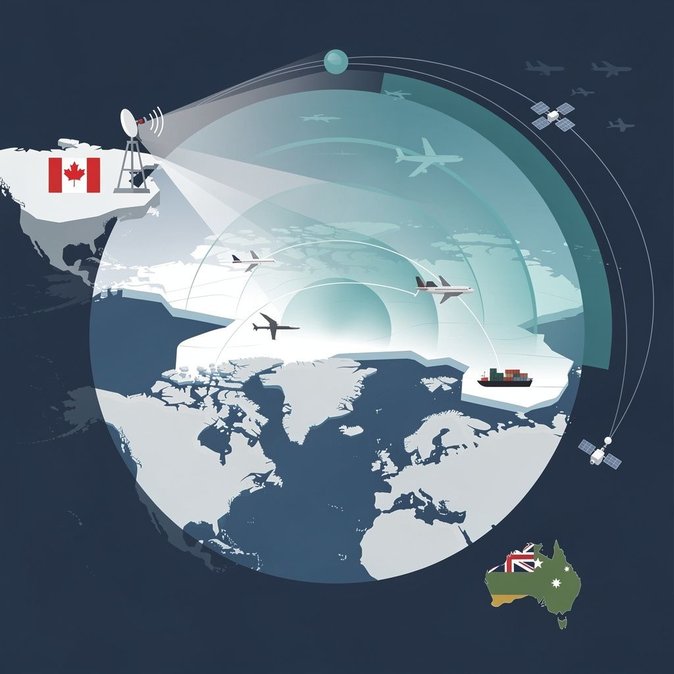
In a late-evening announcement on 21 June 2026 from Canberra, the Government of Canada signed a government-to-government acquisition arrangement with Australia for the purchase and co-development of an Arctic Over-the-Horizon Radar (A-OTHR) system. The CNW release outlines a C$2.5 billion deal with BAE Systems Australia that will deliver long-range surveillance able to track airborne and maritime targets thousands of kilometres before they reach Canadian airspace.
Engineers, contractors and government officials shuttling between Ottawa, Canberra and remote test ranges will need to navigate evolving visa and entry requirements. VisaHQ’s online platform (https://www.visahq.com/canada/) simplifies that process by offering up-to-date guidance, electronic applications and courier services for both Canadian and Australian travel documents, helping stakeholders stay on schedule for the A-OTHR rollout.
Initial operating capability is slated for December 2029, with construction work starting 1 July 2026. The radar will refract signals off the ionosphere, allowing Canada to “see” beyond the curvature of the Earth – a game-changer for monitoring emerging polar air routes, Russian strategic bombers and illicit shipping through melting Arctic sea lanes. For the global-mobility sector, the technology strengthens early-warning capacity that underpins North American Aerospace Defence Command (NORAD) air-traffic management and, by extension, commercial flight safety on trans-polar routes increasingly used by cargo and premium passenger services. Officials emphasised the Industrial and Technological Benefits framework: the project is projected to support 2,270 Canadian jobs annually between 2026 and 2033 and inject nearly C$290 million per year into GDP. Defence-industry analysts note that Canadian SMEs specialised in radar subsystems, electronics cooling and northern logistics will gain export-ready expertise, potentially feeding into civilian air-traffic-management technologies. From a border-security perspective the move represents Canada’s largest single investment in Arctic domain awareness and aligns with Ottawa’s pledge to modernise NORAD. Enhanced detection should allow the Canadian Border Services Agency and Transport Canada to adapt over-flight and maritime-entry protocols, improving risk screening for passenger and cargo movements through northern gateways such as Iqaluit and Inuvik. The partnership also signals deeper Canada–Australia defence industrial ties, mirroring the U.K.-Australia-U.S. (AUKUS) technology-pooling trend. Observers say it strengthens Canada’s hand in Arctic governance debates and could pave the way for shared surveillance data that informs aviation routing, search-and-rescue coordination and remote-work rotations for energy and mining projects in the North.
Engineers, contractors and government officials shuttling between Ottawa, Canberra and remote test ranges will need to navigate evolving visa and entry requirements. VisaHQ’s online platform (https://www.visahq.com/canada/) simplifies that process by offering up-to-date guidance, electronic applications and courier services for both Canadian and Australian travel documents, helping stakeholders stay on schedule for the A-OTHR rollout.
Initial operating capability is slated for December 2029, with construction work starting 1 July 2026. The radar will refract signals off the ionosphere, allowing Canada to “see” beyond the curvature of the Earth – a game-changer for monitoring emerging polar air routes, Russian strategic bombers and illicit shipping through melting Arctic sea lanes. For the global-mobility sector, the technology strengthens early-warning capacity that underpins North American Aerospace Defence Command (NORAD) air-traffic management and, by extension, commercial flight safety on trans-polar routes increasingly used by cargo and premium passenger services. Officials emphasised the Industrial and Technological Benefits framework: the project is projected to support 2,270 Canadian jobs annually between 2026 and 2033 and inject nearly C$290 million per year into GDP. Defence-industry analysts note that Canadian SMEs specialised in radar subsystems, electronics cooling and northern logistics will gain export-ready expertise, potentially feeding into civilian air-traffic-management technologies. From a border-security perspective the move represents Canada’s largest single investment in Arctic domain awareness and aligns with Ottawa’s pledge to modernise NORAD. Enhanced detection should allow the Canadian Border Services Agency and Transport Canada to adapt over-flight and maritime-entry protocols, improving risk screening for passenger and cargo movements through northern gateways such as Iqaluit and Inuvik. The partnership also signals deeper Canada–Australia defence industrial ties, mirroring the U.K.-Australia-U.S. (AUKUS) technology-pooling trend. Observers say it strengthens Canada’s hand in Arctic governance debates and could pave the way for shared surveillance data that informs aviation routing, search-and-rescue coordination and remote-work rotations for energy and mining projects in the North.